Buying guide
The Best Foam Roller for Your Back, And Where Not to Roll
By the IntoInversion teamUpdated
- 3 picks
- 6 sources
- 14 min read
We earn from qualifying purchases made through our links.

Our pick for most backs
Amazon Basics 36 Inch Foam Roller
A plain, long, smooth roller is the right first purchase for almost everyone. It does the one job a roller can do for your back without the extra claims, and it costs little to find out whether you like the position.
- Smooth and long enough to lie along or across
- Firm polypropylene that keeps its shape
- A low spend, so a wrong guess costs little
- Price range
- Budget
Listing onlySpecs from the retail listing; the maker publishes no spec sheet

Best soft roller for a sore back
Choose it if firm rollers feel like too much, or you are returning to activity after a long stretch of avoiding it. Skip it if you want the lowest spend, since this is the priciest of the four.

Best textured roller for the muscles around the spine
Choose it if you already tolerate a plain roller and want more pressure on tight spots in the back, hips and legs. Skip it if you are new to rolling, or your back is sore right now.
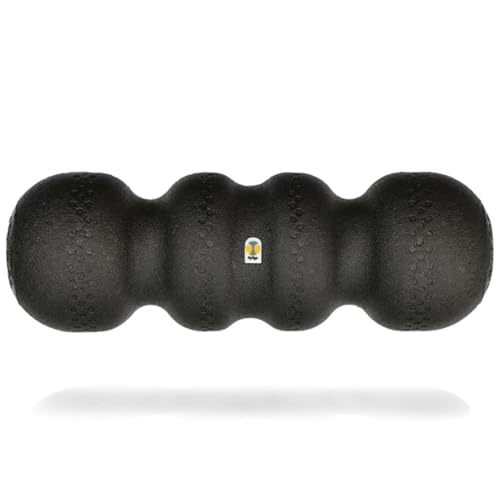
Best contoured roller for the spine channel
Choose it if you want a shaped roller that leaves a channel over the spine while it presses on the muscles either side. Skip it if you are new to rolling. The PRO is the harder version, per the listing.
Foam rollers are cheap, and the evidence for using them on a painful back is thin. We did not test these products on people. We read each Amazon listing, opened the maker’s own page where one existed, and tied every health statement to a named source. When a listing makes a claim we could not confirm, we say so. If you buy through our links we may earn a commission, which never decides which product we pick.
Best Foam Rollers for Your Back at a Glance
Search for a foam roller for your back and you meet four different ideas sold with the same promise: a smooth firm tube, a soft one, a bumpy one and a shaped one. The right choice depends on how sore you are today and what you want the roller to do, so the table sorts them by that.
See our four picks in one table
Our Four Picks
| If you want | Our pick | What decides it |
|---|---|---|
| The simplest, low-cost start | Amazon Basics 36 in | Long, smooth and firm; no claims about your spine |
| Gentler pressure | OPTP PRO-Roller Soft 36 x 6 | Soft EVA foam in a full 36 inch length |
| More pressure on the muscles | TriggerPoint GRID 1.0 | Ridges and nodules at several firmness levels, 13 inches long |
| A channel over the spine | Rollga PRO | Grooved shape; the PRO is the harder version |
We don’t print prices, because they move from week to week. The OPTP costs the most of the four.
The Specs Side by Side
Where a maker’s page was open to us, the column comes from it. Otherwise it comes from the Amazon listing, and where a figure is not published the table says so.
| Spec | Editor's choiceAmazon Basics 36 Inch Foam RollerBudget, price tier 1 of 3Listing only | OPTP PRO-Roller Soft 36 x 6Budget, price tier 1 of 3Maker source | TriggerPoint GRID 1.0Budget, price tier 1 of 3Listing only | Rollga PROBudget, price tier 1 of 3Listing only |
|---|---|---|---|---|
| Adjustment | None: a smooth round cylinder; firmness is fixed | None: soft density, round cylinder | None: zones of different firmness on one surface | None: shaped surface; the PRO is 20% harder than the standard version, per the seller |
| How you use it | The listing names balance, strengthening and flexibility exercises and gives no back instructions | OPTP describes soft density for gentle massage and comfortable exercise; the Amazon listing names full-body positioning, back exercises and self-massage | The listing describes deep tissue rolling of tight muscles and gives no back-specific instructions | The listing describes use on the back, neck, legs, arms and feet |
| Assembly and setup | 36 inch high-density polypropylene foam roller with molded edges, per the listing | 36 by 6 inch soft EVA foam roller, per OPTP | 13 inch EVA-wrapped hollow-core roller with ridges and nodules, per the listing | 18 inch contoured high-density roller with a spine groove, per the listing |
| Buy | See today's price: Amazon Basics 36 Inch Foam Roller on Amazon (opens in a new tab) | See today's price: OPTP PRO-Roller Soft 36 x 6 on Amazon (opens in a new tab) | See today's price: TriggerPoint GRID 1.0 on Amazon (opens in a new tab) | Not linked |
Editor's choiceAmazon Basics 36 Inch Foam RollerListing only- Adjustment
- None: a smooth round cylinder; firmness is fixed
- How you use it
- The listing names balance, strengthening and flexibility exercises and gives no back instructions
- Assembly and setup
- 36 inch high-density polypropylene foam roller with molded edges, per the listing
OPTP PRO-Roller Soft 36 x 6Maker source- Adjustment
- None: soft density, round cylinder
- How you use it
- OPTP describes soft density for gentle massage and comfortable exercise; the Amazon listing names full-body positioning, back exercises and self-massage
- Assembly and setup
- 36 by 6 inch soft EVA foam roller, per OPTP
TriggerPoint GRID 1.0Listing only- Adjustment
- None: zones of different firmness on one surface
- How you use it
- The listing describes deep tissue rolling of tight muscles and gives no back-specific instructions
- Assembly and setup
- 13 inch EVA-wrapped hollow-core roller with ridges and nodules, per the listing
Rollga PROListing only- Adjustment
- None: shaped surface; the PRO is 20% harder than the standard version, per the seller
- How you use it
- The listing describes use on the back, neck, legs, arms and feet
- Assembly and setup
- 18 inch contoured high-density roller with a spine groove, per the listing
Maker source from the maker's own page or manual, not independently testedListing only retail listing, no maker spec sheetNot stated the maker publishes nothing
OPTP’s own page for the soft roller states no weight limit or warranty, and the other listings we read give none either. The row that separates these four is the surface, because the surface decides how hard the roller presses into the same body weight.
Does a Foam Roller Help Back Pain?
This is the question most readers arrive with, and the honest answer is that it is not settled. A foam roller is a widely used tool, and plenty of people like how it feels. The studies we could open measure other things.
What the Reviews Show
A 2015 systematic review of 14 studies found that rolling with a foam roll or roller massager appeared to have short-term effects on joint range of motion without hurting muscle performance, and its authors said there was no consensus on the best program (Cheatham, 2015). A 2019 meta-analysis of 21 studies found a small gain in flexibility when rolling before exercise, and called the overall effects on performance and recovery rather minor and partly negligible (Wiewelhove, 2019).
Neither review is about back pain. They pool studies of athletes and active adults rolling for flexibility, soreness and performance. That is useful for a roller’s plain job, loosening up, and it says little about a back that hurts.
The American College of Physicians guideline on low back pain, which we read in summary, tells people with acute or subacute pain to choose non-drug treatments such as superficial heat, massage, acupuncture or spinal manipulation, and people with chronic pain to start with exercise and similar options (Qaseem, 2017). It does not name foam rolling. We read that as: rolling is not recommended against, and not recommended for either.
Cleveland Clinic’s 2021 article on massage tools says rollers can relieve back pain in trigger points (Cleveland Clinic, 2021). That is a chiropractor’s advice, not a trial result, so we weigh it as experience and not as evidence.
The One Lumbar Trial (in People Without Pain)
The closest trial we found is a 2024 randomized trial in Frontiers in Physiology by Fijavž and colleagues. It enrolled 43 healthy adults aged 18 to 60 with no back problems. One group rolled three times a week for four weeks with a softer Blackroll Med roller, working the sole of the foot, calf, back of the thigh, buttocks and lower back at low pressure, and the other group did nothing (Fijavž, 2024).
At four weeks the rolling group had better lumbar flexion, side bending and pressure pain threshold than the control group, and the differences were still there at six months (Fijavž, 2024). The authors listed the limits themselves: no blinding, pressure rated by the participants, home sessions done without supervision, a dropout of 16.3% by six months, and only healthy people studied (Fijavž, 2024).
Read it carefully. The program rolled the feet, legs and glutes as well as the lower back, so we cannot tell which part did what. And these were people without pain, so it is not evidence that a roller relieves back pain. It does suggest that gentle, regular rolling is tolerated by healthy adults and can change how the back moves and how sore it feels to pressure.
What Is Still Unknown
We found no trial of a foam roller alone in people with lower back pain. We did not find one in our searches; we cannot say none exists. We also found nothing comparing flat and bumpy rollers for the back, or comparing soft and firm. So any advice on density or surface, including ours below, rests on how the products are built and on what physical therapists and clinics tell patients, not on a head-to-head test.
Flat or Bumpy: Which Foam Roller for Your Back?
Nobody has tested this, so here is the practical difference. A smooth roller spreads your body weight across a wide strip. A textured roller has ridges or nodules, so the same weight lands on smaller spots and feels sharper.
- Smooth: better for lying back across the upper back, for first-time users, and for a back that is sore today. It is also the easiest to keep steady.
- Textured: better for working along the muscles beside the spine, the glutes and the thighs once you already tolerate pressure. It is a muscle tool more than a stretching tool.
- Shaped or grooved: a middle route. The groove leaves a channel over the spine, so the weight goes onto the muscles on either side. We found no test of whether that is safer or more effective than a plain roller, and the seller’s claims about protecting the spine are the seller’s words.
If you are unsure, buy smooth. You can always add a textured roller later, and a smooth one stays useful for stretching and balance exercises.
Soft, Firm and Length
Two other choices matter more than most buyers expect: how firm the roller is and how long.
How Firm
Cleveland Clinic’s guide to massage rollers says that if you are in great shape you might want a very hard roller, one that does not dent when you squeeze it, and that if you prefer a softer touch you should choose one with more give (Cleveland Clinic, 2021). We read that as pointing beginners and sore backs toward a softer roller, and fitter users toward firm. The article is built around advice from a chiropractor, Chad Adams, DC, not a trial.
How Long
A 36 inch roller runs the whole length of your spine, so you can lie along it with head and tailbone supported, or across it for the upper back. An 18 inch roller is easier to carry and fine for the legs, but it only supports part of the back and can feel wobbly under the shoulder blades. A 13 inch roller like the GRID is a muscle tool: you roll it under a body part, you do not lie along it.
For the back specifically, we would buy 36 inches. Our guide to upper back stretchers covers the shorter 18 inch Amazon Basics roller, the Backpod and the peanut ball, so we won’t repeat them here.
Material
Polypropylene, the plastic used for the Amazon Basics roller, keeps its shape and is the firmer choice. EVA foam, used for the OPTP and the GRID, can be made softer. The OPTP listing says its roller is closed-cell foam and wipes clean easily, unlike open-cell rollers.
Best Overall: Amazon Basics 36 Inch High Density Foam Roller
The simple choice that does what a roller can do.
The plain first rollerListing only
by Amazon Basics
Best for a first foam roller you can lie along or across, with no claims to doubt.
Skip it if you find firm rollers painful, or you cannot get down to and up from the floor comfortably.
A long, smooth, firm roller with no claims about the spine to doubt, at a low spend. The right first purchase for lying along or across your back.
- Price range
- Budget
What we like
- Low spend
- 36 inches runs the length of the spine
- Listing makes no health claims
- Wipes clean per the listing
Keep in mind
- Firm, which a sore back may not like at first
- Round, so it can shift under you
- No back instructions, weight limit or warranty in the listing
Full specs
- Price range
- Budget
- Weight capacity
- Not stated
- Settings
- None: a smooth round cylinder; firmness is fixed
- In the box
- 36 inch high-density polypropylene foam roller with molded edges, per the listing
- Use
- The listing names balance, strengthening and flexibility exercises and gives no back instructions
- Warranty
- Not stated
Listing onlyFrom the retail listing; no maker spec sheet
We may earn a commission. It never changes what we pick, or the order picks appear in.
What the Listing Says
A high-density roller in blue speckled, 36 inches long, made of firm polypropylene with molded edges. The listing calls it light, easy to carry to class and easy to wipe clean, and describes it for balance, strengthening and flexibility exercises. It says nothing about back pain.
What You Give Up
It is firm and has no texture, so a sore back may not enjoy it at first. It is round, so it can shift under you. The listing gives no instructions for the back and states no weight limit or warranty.
Who It Suits
Anyone who wants to try rolling for their back with a small outlay. If it turns out you like the position, you can move to a softer or a textured roller afterward. If firm is too much, go to the OPTP.
Best Soft Roller: OPTP PRO-Roller Soft 36 x 6
A gentler roller, listed for gyms, studios, clinics and home use.
The gentle oneMaker source
by OPTP
Best for people who find firm rollers too much and want a full-length roller with some give.
Skip it if you want the lowest spend, or a roller with texture.
A full-length soft roller from a maker that names clinics among its users, for backs that find firm rollers too much.
- Price range
- Budget
What we like
- Soft density with some give
- Full 36 inch length
- Closed-cell EVA per the listing, wipes clean
Keep in mind
- Highest spend of the four
- No texture
- No weight limit or warranty stated by OPTP
Full specs
- Price range
- Budget
- Weight capacity
- Not stated
- Settings
- None: soft density, round cylinder
- In the box
- 36 by 6 inch soft EVA foam roller, per OPTP
- Use
- OPTP describes soft density for gentle massage and comfortable exercise; the Amazon listing names full-body positioning, back exercises and self-massage
- Warranty
- Not stated
Maker sourceFrom the maker's product page. Not stated means the maker publishes nothing.
We may earn a commission. It never changes what we pick, or the order picks appear in.
What the Listing and the Maker Say
OPTP’s own product page describes highly durable EVA foam with a soft density for gentle massage and comfortable exercise, in four sizes including 36 by 6 inches. The Amazon listing for the 36 inch size calls it closed-cell EVA foam for gym, studio, clinic or home, and says it suits full-body positioning, back exercises and self-massage.
What You Give Up
It costs more than the other picks here. OPTP’s page states no weight limit and no warranty, and we found neither elsewhere. Its softness makes it a gentler way to lie along your back. It does not make it a treatment.
Who It Suits
Anyone whose back is sore, who is older or less used to exercise, or who found the plain roller too hard.
Best Textured Roller: TriggerPoint GRID 1.0
For pressure on the muscles, not for lying back over.
The textured step upListing only
by TRIGGERPOINT
Best for people who already tolerate rolling and want varied pressure on the muscles of the back, hips and legs.
Skip it if you are new to rolling, your back is sore today, or you want a smooth surface to lie back across.
A textured muscle roller for people who already tolerate rolling and want varied pressure beside the spine, on the glutes and on the thighs.
- Price range
- Budget
What we like
- Varied firmness zones
- Compact at 13 inches
- Firmer than a plain foam roller per the listing
Keep in mind
- Too short to lie along
- Texture presses harder on a sore back
- No weight limit in the listing
Full specs
- Price range
- Budget
- Weight capacity
- Not stated
- Settings
- None: zones of different firmness on one surface
- In the box
- 13 inch EVA-wrapped hollow-core roller with ridges and nodules, per the listing
- Use
- The listing describes deep tissue rolling of tight muscles and gives no back-specific instructions
- Warranty
- Not stated
Listing onlyFrom the retail listing; no maker spec sheet
We may earn a commission. It never changes what we pick, or the order picks appear in.
What the Listing Says
A 13 inch roller wrapped in EVA foam around a hollow core, with a raised pattern of ridges and nodules in zones of different firmness. The listing says it is firmer than traditional foam rollers and describes it as deep tissue compression for tight muscles. The listing gives no weight limit, so we don’t print one.
What You Give Up
At 13 inches it is a muscle tool. You roll it under a body part, rather than lie on it. The texture presses harder than a smooth roller and may be too much for a sore back. The listing’s claims about blood flow and oxygen come with no study named, so we cannot confirm them.
Who It Suits
Regular rollers who want a firmer, textured tool for the muscles beside the spine, the glutes and the thighs. If you want a roller to lie back over, buy a long smooth one instead.
Best Contoured Roller: Rollga PRO
A shaped roller aimed at the back.
The shaped oneListing only
by Rollga
Best for people who want a contoured roller that leaves a channel over the spine while pressing on the muscles either side.
Skip it if you are new to rolling, or your back is sore today, since the PRO is the harder version.
A shaped roller with a channel over the spine, for experienced rollers who want a design made for the back. Its protective claims are the seller's own.
- Price range
- Budget
What we like
- Channel over the spine
- Made for the back per the listing
- Harder PRO version for experienced users
Keep in mind
- Harder, so not a first roller
- Spine-protection claims are untested
- No weight limit in the listing
We are not linking to this model at the moment. The specs below still hold. See the alternatives we would pick instead.
Full specs
- Price range
- Budget
- Weight capacity
- Not stated
- Settings
- None: shaped surface; the PRO is 20% harder than the standard version, per the seller
- In the box
- 18 inch contoured high-density roller with a spine groove, per the listing
- Use
- The listing describes use on the back, neck, legs, arms and feet
- Warranty
- Not stated
Listing onlyFrom the retail listing; no maker spec sheet
What the Listing Says
The listing sells it as a high density, ergonomic roller with patented grooves that support the spine and shoulder blades while bumps press on tight spots. It says the PRO is 20% harder than the standard Rollga and best for people with rolling or deep tissue massage experience.
What You Give Up
The listing’s claims that the grooves protect the spine and bone, and its flexibility figure, are the seller’s words. We found no independent test of this roller. The listing gives no weight limit. If you are new to rolling, the plain roller above is the better start.
Who It Suits
People who have rolled before, like firm pressure and want a shape designed for the back. If you are unsure, start with the plain roller and see whether you use it.
Should You Foam Roll Your Lower Back?
This is the question behind most of the searching, and the honest answer is: carefully, and probably not directly.
Upper Back
The upper back, the part behind your ribs, is where a roller sits most naturally. Lying with a roller under your shoulder blades lets the upper back bend backward a little over a rounded shape. That position is covered in our upper back stretcher guide, which is where to go for the Backpod; the movements themselves are in our thoracic extension guide.
Lower Back
The lower back is different. A roller placed under your waist pushes the lumbar spine into an arch, with no ribs to limit it, and with your body weight pressing down. Opinions differ on how risky that is, and we found no trial that settles it. The Fijavž trial did roll the lower back, at low pressure and under supervision at first, in healthy people (Fijavž, 2024). We found no trial of lumbar rolling in people with back pain.
Our view is conservative, because the downside is an irritated back and the upside is comfort. If you roll the low back at all, keep the pressure light, use a soft roller, support your weight with your legs and hands, and never roll directly over the bones of the spine.
Roll Around It Instead
The safer way to use a roller on a stiff lower back is to leave the lumbar spine alone and work the muscles that attach near it. The glutes, the back of the thighs and the hips are the usual suspects, and the Fijavž program included the buttocks and back of the thigh (Fijavž, 2024). Sit on the roller and shift your weight onto one side, or lie on your side with it under the outer hip. For a stronger stretch for the lower back, our lower back stretcher guide covers arches and the Teeter P2. For heat instead, see our heating pad guide.
How to Use a Foam Roller on Your Back
No study we found tested a session length for back rolling, so this is a mix of a maker’s guidance, Cleveland Clinic’s advice and common sense, and we mark which is which.
A Gentle Upper Back Session
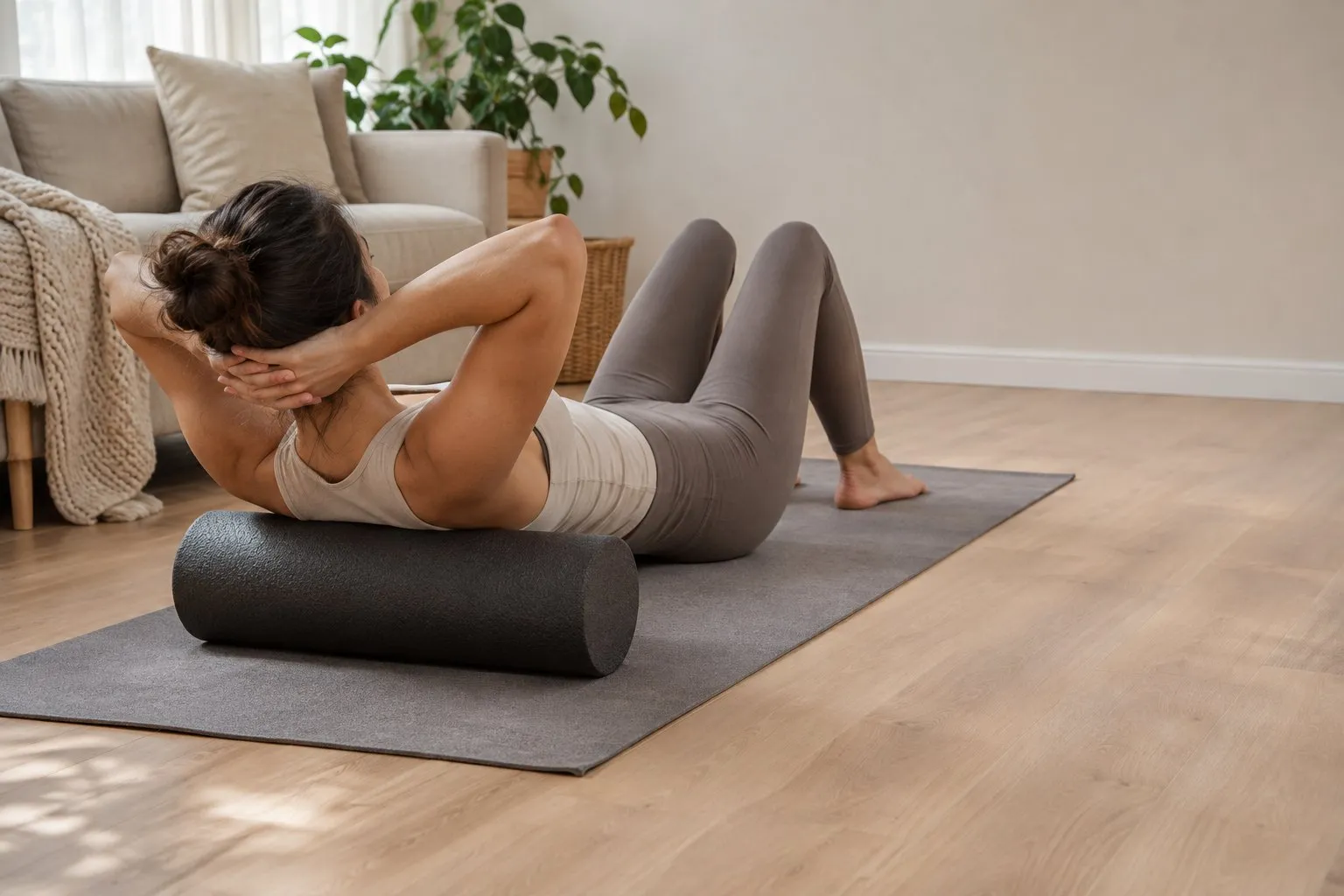
This part is our suggestion, not a maker’s. Lie on a mat, not a slippery floor. Place the roller across your upper back below the shoulder blades, bend your knees with your feet flat, and support your head with your hands. Lift your hips slightly and shift a few inches up and down, then rest on any tight spot for a few breaths. Start with a minute or two and see how your back feels the next morning. Add time only if it felt better, not merely different.
Pressure and Pace
Cleveland Clinic’s advice is less wiggle, more pressure on the tight spot, and that it may help to roll just above or below a trigger point (Cleveland Clinic, 2021). Its chiropractor suggests three to five minutes, up to five or six times a day (Cleveland Clinic, 2021). That is one clinician’s routine, and with a sore back we would start with far less. In the Fijavž trial, pressure was kept at or below 3 out of 10 on a pain scale, with slow, metronome-paced strokes, which is a useful ceiling for beginners (Fijavž, 2024). Mild pressure feels like a deep massage, not like pain.
Stop Signs
Cleveland Clinic says to contact a physician or physical therapist if you feel sharp pain while foam rolling (Cleveland Clinic, 2021). We would add tingling or numbness in the arms or legs, dizziness, and any chest discomfort. Get off by rolling to the side, not by sitting straight up.
Who Should Skip It
None of these products comes with a full list of who should avoid it. These groups should ask a doctor first, and we are not able to tell you rolling is safe for them.
Osteoporosis, Fractures and Surgery
The Bone Health and Osteoporosis Foundation tells people with osteoporosis not to flex or bend the spine forward, says that leaning back reduces stress on the front of the spine, and also says activities that place stress on the spine can raise the chance of breaking a bone (Bone, 2026). A roller concentrates your body weight on a small area of the back, and we found no source that tests foam rollers in people with osteoporosis. A recent rib or spine fracture and any spinal surgery belong on the same ask-first list.
A History of Blood Clots
We could not open a clinical source that settles whether foam rolling is safe after a blood clot, so we make no claim either way. Pressure applied to the legs is the usual concern people raise, and the decision belongs with your doctor.
New or Worsening Pain
Pain that wakes you at night, keeps getting worse, or does not ease after a few weeks also deserves an examination. A roller is a comfort tool, and comfort is not a diagnosis.
When Rolling Isn’t Enough
If a roller does nothing for you after a few weeks, or you want a stronger kind of stretch, there are other steps.
Other Ways to Move the Back
Staying active and changing position often is the dull but common advice. Our guide to decompressing your spine covers positions that need no equipment and says plainly what is and is not known about each.
Arches, Inversion and Heat
An arch or a lower back stretcher is a different load on the spine; start with our lower back stretcher guide. Inversion is a much stronger step with more caution. If you are curious, our inversion tables for back pain page covers the options and who should stay away. The American College of Physicians lists superficial heat among the non-drug options for acute and subacute low back pain (Qaseem, 2017), and our heating pad guide covers it.
The Honest Verdict
Choose by how your back feels today. If you just want to try it, buy the Amazon Basics 36 inch roller. If firm is too much, the OPTP soft roller is the gentler way to lie along your spine. If you already roll and want more pressure on the muscles, the GRID is the step up, and the Rollga PRO is for experienced rollers who like a shaped design. Whichever you choose, it is a comfort tool and not a cure, and persistent or worsening pain means seeing a clinician rather than buying a different roller.
Your questions, answered
Frequently Asked Questions
Why shouldn't you use a foam roller on your lower back?
The main worry is mechanical: a roller under your waist makes the lower back arch backward, and the lumbar spine has no ribs to limit it. Opinions differ on how risky that is, and we found no trial of lumbar rolling in people with back pain. Rolling the muscles around the lower back is the safer habit.
Is a flat or bumpy foam roller better?
Nobody has tested the two against each other for back pain, so neither is proven better. A smooth roller spreads pressure and suits lying across it. A bumpy one concentrates pressure on muscle and feels stronger. Beginners and sore backs usually do better starting with smooth and soft, then trying texture only if it feels fine.
Will a foam roller help my lower back pain?
We found no trial that tested a foam roller on its own in people who have lower back pain. The closest trial we opened used healthy adults, and its program included the feet, legs and glutes too. A roller may feel good for tight muscles, but treat it as a comfort tool and see a clinician if pain lingers.
Where shouldn't you foam roll?
We found no trial that sets the limits, so this is caution and not a rule. Skip the lower back and the neck, avoid rolling over bone, and stay off any area that is swollen, bruised or newly injured. If rolling brings sharp pain, tingling or numbness, stop. People with osteoporosis, a recent fracture or spinal surgery should ask a doctor first.
Can you decompress your spine with a foam roller?
We found no study showing that a foam roller decompresses the spine. Lying back across one changes your position and may feel like a stretch through the upper back, but that is not the same as unloading your discs. Our guide to decompressing your spine covers what is known about the options and who should avoid them.
How to use a foam roller to help your back?
Lie on a mat with the roller under your upper back, head supported by your hands, knees bent and feet flat. Shift a little to find tight spots and rest on them briefly, keeping the pressure moderate. Start with a minute or two, and stop at sharp pain, tingling or numbness. Avoid rolling the lower back itself.
6 sources used for this guide
Each linked to the original. Citations in the text jump here.
View sources
Fijavž J, Frangež M, Vauhnik R. Effects of lower back foam rolling on the pressure pain threshold and the range of motion of the lumbar spine in healthy individuals. Frontiers in Physiology 2024;15:1476342.
Cleveland Clinic (advice from Chad Adams, DC). Massage Rollers and More: How To Ease Neck and Back Pain With Simple Tools. health.clevelandclinic.org, 5 February 2021.
Cheatham SW, Kolber MJ, Cain M, Lee M. The Effects of Self-Myofascial Release Using a Foam Roll or Roller Massager on Joint Range of Motion, Muscle Recovery, and Performance: A Systematic Review. International Journal of Sports Physical Therapy 2015;10(6):827-838.
Wiewelhove T, Doweling A, Schneider C, Hottenrott L, Meyer T, Kellmann M, Pfeiffer M, Ferrauti A. A Meta-Analysis of the Effects of Foam Rolling on Performance and Recovery. Frontiers in Physiology 2019;10:376.
Qaseem A, Wilt TJ, McLean RM, Forciea MA, Clinical Guidelines Committee of the American College of Physicians, et al. Noninvasive Treatments for Acute, Subacute, and Chronic Low Back Pain: A Clinical Practice Guideline From the American College of Physicians. Annals of Internal Medicine 2017;166(7):514-530.
Bone Health & Osteoporosis Foundation. Protecting Your Spine. bonehealthandosteoporosis.org, accessed October 2026.