Health guide
The Best Sleeping Position for Sciatica, And How to Set Up the Pillows
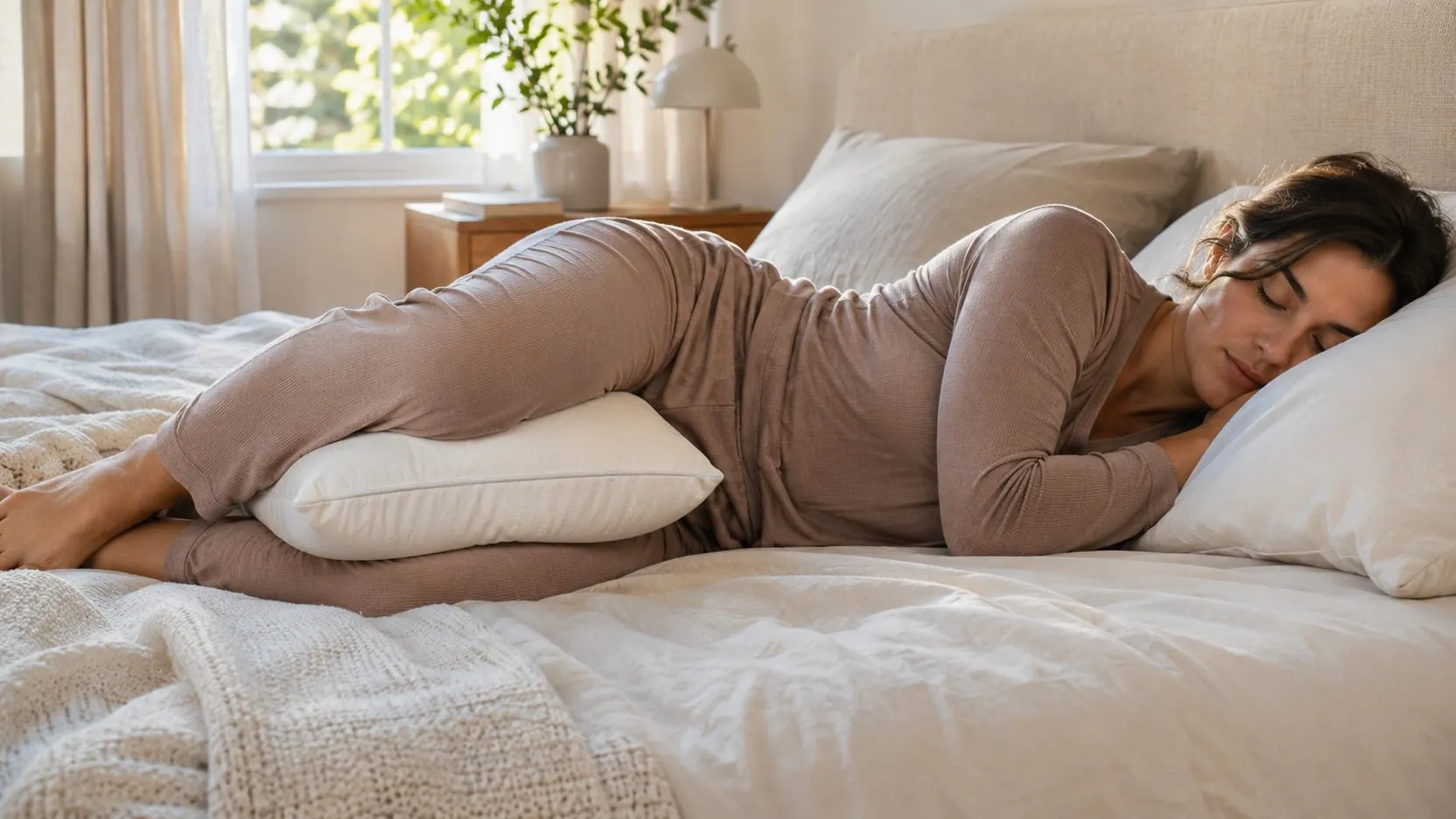
Sciatica pain has a way of getting louder at night, just when you want to switch off. Finding the best sleeping position for sciatica is mostly about taking pressure off the irritated nerve and keeping your spine from twisting or sagging for hours. This guide covers the positions that Cleveland Clinic, Mayo Clinic, Harvard Health and Hospital for Special Surgery suggest, exactly where the pillows go, how your mattress fits in, what the only sleep posture study we found actually measured, and the night-time symptoms that mean you should see a doctor. We did not test anyone; every claim names its source.
The Best Sleeping Positions for Sciatica
Cleveland Clinic is direct about it: there is no perfect sleeping position for sciatica, but one of a few options may work best for you (Cleveland Clinic, 2025). Here they are, with the pillow set-up for each.
On Your Side, Pillow Between the Knees
Side sleeping can take pressure off the sciatic nerve, especially if you sleep on the side opposite the pain (Cleveland Clinic, 2025). Mayo Clinic suggests drawing your legs up slightly toward your chest and putting a pillow between your legs, which helps align the spine, pelvis and hips (Mayo Clinic, 2024). Cleveland Clinic’s physical therapist adds a pillow behind your back so you do not roll (Cleveland Clinic, 2025), and Harvard Health suggests a thick pillow under your head to keep the upper spine aligned (Harvard Health Publishing). A full-length body pillow does several of these jobs at once.
On Your Back, Pillow Under the Knees
Back sleeping promotes good spinal alignment (Cleveland Clinic, 2025). Mayo Clinic suggests a pillow under the knees to relax the back muscles and keep the natural curve of the lower back, and a small rolled towel under the waist if you need more support (Mayo Clinic, 2024). Cleveland Clinic suggests a small pillow under the neck and head but not the shoulders (Cleveland Clinic, 2025).
Slightly Raised, for Stenosis
If spinal stenosis, a narrowing of the spaces in the spine, is behind your sciatica, a slightly rounded position may help open those spaces. Cleveland Clinic suggests a large wedge pillow under your head and upper back, a recliner or adjustable bed with the head raised, or curling up on your side in the fetal position, and warns that these positions may cause more pain if stenosis is not the cause (Cleveland Clinic, 2025). Harvard Health describes a home version for back sleepers: two thick pillows behind your back to prop you up, and one or two flatter ones under your knees (Harvard Health Publishing).
On Your Stomach: Usually the One to Avoid
Stomach sleeping forces your back to arch and your head to turn, and Cleveland Clinic says it is typically best avoided with sciatica, though for a few people arching the back actually relieves their sciatica (Cleveland Clinic, 2025). Harvard Health calls it the least preferred position, and suggests that if it is the only way you can sleep, you use a flat pillow or none under your head and a plump one under your hips (Harvard Health Publishing).
| Position | Pillow set-up | Best for | Watch out |
|---|---|---|---|
| Side, knees bent | Pillow between knees, thick one under head, one behind back | Most people; try the side opposite the pain | Do not let the top knee drop and twist the spine |
| Back | Pillow under knees, small one under head only | People whose pain eases lying straight | A soft mattress lets the hips sag |
| Raised or curled | Wedge or stacked pillows behind back, pillows under knees | Sciatica from spinal stenosis | May hurt if stenosis is not the cause |
| Stomach | Flat or no head pillow, plump pillow under hips | Only if nothing else lets you sleep | Back arches and neck twists |
Which Position Suits Your Sciatica?
Sciatica is a symptom, not one condition, and the right position partly depends on what is irritating the nerve.
If Bending Backward Feels Better
Some people with sciatica feel better when they arch slightly. Cleveland Clinic notes that for a few people with sciatica, arching the back provides relief (Cleveland Clinic, 2025). Back sleeping with only a small knee pillow, or even stomach sleeping with hip support, may suit you. Our guide to McKenzie exercises explains how clinicians test which direction helps.
If Bending Forward Feels Better
If you have been told spinal stenosis is the cause, the raised or curled positions above are the ones Cleveland Clinic aims at that group (Cleveland Clinic, 2025). If you have not been diagnosed, ask a clinician rather than guessing from symptoms, because the same positions can make other causes worse.
If Nothing Is Clear
An HSS spine specialist says back pain is very person-specific, with as many best positions as there are people with back pain (HSS, 2020). Cleveland Clinic’s physical therapist suggests getting into a neutral position, noticing what hurts and what feels good, and adjusting from there (Cleveland Clinic, 2025). Give each change a few nights before judging it.
Mattress and Pillows
Medium-Firm, Usually
Cleveland Clinic says a review of studies found a medium-firm mattress best for low back pain relief, and suggests first finding a comfortable position on the mattress you already have, using pillows or a topper, before you buy anything (Cleveland Clinic, 2025). The HSS specialist gives a simple test: if your lower back sinks below your shoulders and feet, the mattress is too soft; if it allows no sinking at all, it puts too much pressure on pressure points (HSS, 2020). Harvard Health adds that firmer is not necessarily better and that a money-back guarantee gives you time to test one (Harvard Health Publishing).
Knee Pillows and Wedges
You do not need a special product to start. Regular pillows work fine, and a body pillow is a good option because it molds to you and stays in place (Cleveland Clinic, 2025). Harvard Health mentions a two-piece wedge cushion for back sleepers, with one part under the legs and one under the back (Harvard Health Publishing).
What the Research Says About Sleep Posture
Almost everything above is clinical advice, not trial results, and the honest sources say so.
The Advice Is Mostly Untested
The HSS spine specialist says sleeping on the back is traditionally thought best for the spine but that this has not been scientifically proven, and that there is no medical evidence that stomach sleeping is a problem (HSS, 2020). That is a useful counterweight to pages that promise one perfect position.
The One Study That Filmed Sleepers
The closest thing to direct evidence we found is a 2021 cross-sectional study that filmed 53 adults sleeping at home over two nights. People who woke with spinal symptoms spent more time in provocative sleep postures and slept worse; in the low back group, time in those postures was about three times that of controls, but the difference was not statistically significant, and the authors say the study may have lacked the power to show one (Cary, 2021). It was small, included adults aged 18 to 45, did not focus on sciatica, and cannot show that posture caused the symptoms.
A Better Night Starts Before Bed
Stretch, Then Lie Down
Cleveland Clinic’s physical therapist suggests stretches such as the piriformis stretch and cobra pose, one to two minutes three to five times a day, including right before bed (Cleveland Clinic, 2025). Gentle nerve flossing is another option to discuss with your clinician.
Heat Before Bed, Never While Asleep
A short spell of heat before bed can ease sore muscles. Do not sleep on a heating pad: a University of Utah Burn Center nurse manager says leaving a pad in one place or falling asleep on it can cause a second-degree burn over a few hours (University of Utah Health, 2018). Our guide to the best heating pads for back pain covers auto shut-off and safe use.
Keep Moving During the Day
NICE tells clinicians to encourage people with low back pain and sciatica to keep up normal activities (NICE, 2016). Cleveland Clinic makes the same link: what you do while awake, such as staying active and working on posture, affects how bad the pain gets at night (Cleveland Clinic, 2025). Harvard Health notes that the vast majority of people with sciatica get better within a few weeks (Harvard Health Publishing).
When Night Pain Is a Warning Sign
Emergency Signs
Go to an emergency department at once if, since your back pain began, you have new difficulty passing or controlling urine, incontinence, numbness around the back passage or genitals, or worsening pain or weakness in both legs (Bexley MSK, NHS).
Pain That Lying Down Does Not Ease
An NHS physiotherapy service advises seeing a GP if spinal pain keeps getting worse, is not relieved by lying down and keeps you awake throughout the night despite a week or two of advice and exercise, and a professional assessment if it comes with fever, chills or unexplained weight loss (Dynamic Health, NHS). Do not try to solve that with pillows.
Inversion and Recliners
Some people with sciatica end up sleeping in a recliner, or ask whether an inversion table before bed would help. Our pages on inversion tables for sciatica and inversion chairs cover who might try one and who should not.
The Takeaway
For most people, the best sleeping position for sciatica is on the side with a pillow between the knees, or on the back with a pillow under them. If stenosis is the cause, try a slightly raised or curled position; if arching helps, back or supported stomach sleeping may suit you. Use pillows to stop the spine twisting or sagging, aim for a medium-firm surface, and never sleep on a heating pad. If night pain will not ease whatever you do, or comes with bladder, bowel or leg strength changes, see a doctor.
Your questions, answered
Frequently Asked Questions
What sleeping position is best for sciatica?
There is no single best one. Side sleeping with a pillow between the knees, often on the side opposite the pain, and back sleeping with a pillow under the knees are the two positions clinicians suggest most. If spinal stenosis causes your sciatica, a slightly raised or curled position may suit you better. Comfort is the deciding test.
Why does sciatica pain get worse at night?
Partly because you stop moving. An HSS spine specialist points out that during the day you can shift position to ease back pain, while asleep you cannot keep repositioning. Lying still in one awkward posture for long stretches may add to it. Pain that is severe at rest and not eased by lying down needs a doctor's assessment.
What positions worsen sciatica?
For most people, lying flat on the stomach with the back arched and the head twisted is the one to avoid, and sitting curled up for hours can aggravate it too. It varies: some people with stenosis feel worse lying flat, and a few find arching the back eases their leg pain. Change any position that sends pain further down the leg.
Is heat or ice better for sciatica pain?
Either can help short term. Cleveland Clinic suggests heat from a heating pad or hot water bottle to ease soreness, and an ice pack when sciatica is new or newly inflamed. Use heat for short spells before bed, with a layer of fabric, and never fall asleep on a heating pad, because a burn can develop over a few hours.
9 sources used for this guide
Each linked to the original. Citations in the text jump here.
View sources
Cleveland Clinic (advice from Cara Sieberth, PT). How To Get Better Sleep With Sciatica Pain. health.clevelandclinic.org, 21 August 2025.
Mayo Clinic Staff. Sleeping positions that reduce back pain. mayoclinic.org, 19 January 2024.
Harvard Health Publishing. 5 tips for coping with sciatica. health.harvard.edu.
Hospital for Special Surgery (Robert S. Griffin, MD, PhD). 5 Things You Should Know about Sleep and Low Back Pain. hss.edu, 10 December 2020.
Cary D, Jacques A, Briffa K. Examining relationships between sleep posture, waking spinal symptoms and quality of sleep: A cross sectional study. PLoS One 2021;16(11):e0260582 (correction published 2024).
University of Utah Health, The Scope (interview with Brad Wiggens, Burn Center). Heating Pads Can Cause Second-Degree Burns. healthcare.utah.edu, The Scope, 23 November 2018.
Bexley MSK (NHS). Lumbar Radiculopathy. msk-bexley.nhs.uk.
Dynamic Health Physiotherapy (NHS). Mid-back pain. dynamichealth.nhs.uk.
National Institute for Health and Care Excellence (NICE). Low back pain and sciatica in over 16s: assessment and management, Recommendations. NICE guideline NG59, published 30 November 2016, last updated 29 July 2026.