Buying guide
Cervical Traction Device: How Pneumatic, Over-the-Door and Inflatable Units Compare
By the IntoInversion teamUpdated
- 17 sources
- 11 min read
We earn from qualifying purchases made through our links.
Our pick for prescribed home traction
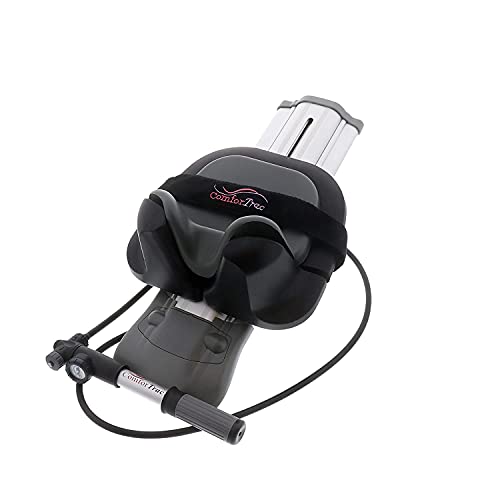
ComforTrac Deluxe Cervical Traction
If a physical therapist or doctor wants you on home cervical traction, the ComforTrac is the device built around that job: a hand pump, a force gauge, adjustable wedges and angle, and instructions written for a clinician. It is also the only device on this page that tells you how hard it is pulling. Without a prescription or a clinician to set it up, a gentler tool is the safer start.
- A gauge shows the force, so a prescribed dose can be repeated
- A release button stops the pull at once and allows pull-and-release cycles
- Free-standing: no door or frame needed
- Price range
- Premium
Maker sourceSpecs from the maker's own product page
We did not test these devices on people. We read each maker’s own instructions and warnings, checked the FDA records ourselves, and tied every health claim to a named review or guideline. If you buy through our links we may earn a commission, which never decides what we pick.
Cervical Traction Devices at a Glance
A cervical traction device is any home product that pulls the head away from the shoulders. That is a narrower group than the “neck stretcher” shelf, where most products only support the neck. This page keeps the devices that pull, and the table shows how they differ.
| Type | How it pulls | How the dose is set | Typical cost tier |
|---|---|---|---|
| Pneumatic unit (Saunders, ComforTrac) | A hand pump drives a head carriage while you lie down | A force gauge and a release button; a clinician sets the numbers | premium |
| Over-the-door set | A counterweight system hung over a door | By the weight you hang, which you choose | budget |
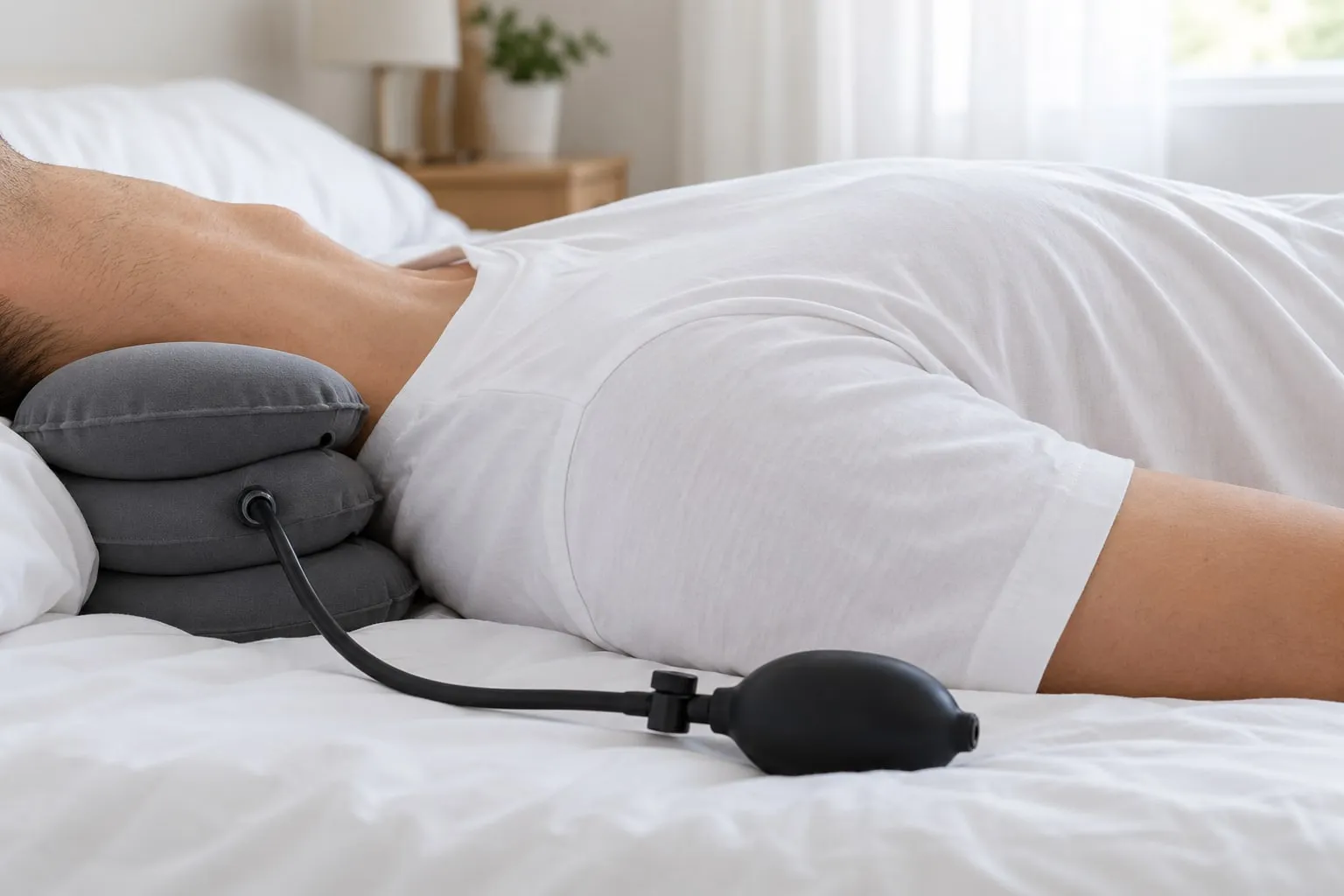
| Inflatable collar | You pump it up and it lifts the head off the shoulders | By how many pumps; no gauge on the cheap models | budget |
Foam C-curve relaxers, orthotic blocks and door hammocks are covered in our guide to the best neck stretcher. They are passive or hand-adjusted supports, and we keep them there so this page can stay on the devices that apply a set pull.
We don’t print prices, because they move from week to week. The tier above is the useful number: the pneumatic units cost many times more than the other two kinds.
Why the Dose Is the Real Difference
With a foam pillow, the force is capped by the weight of your head. With a traction device the force is yours to set, which is why it can help more and hurt more. A device that shows the number lets you repeat a session. One that does not leaves you judging by feel.
Saunders vs ComforTrac vs Over-the-Door
Three names come up in almost every search for a home cervical traction device. They do the same job in three different ways, and the differences are mostly about who controls the pull.
Saunders: Read the Maker’s Instructions First
Saunders is the brand most people mean when they search “Saunders cervical traction.” Before you buy one, read the maker’s current instructions for its force range, angle settings and prescription terms. We print no Saunders figures, because we only print what we have read in the maker’s own documents.
We do not list a Saunders pick for that reason. A device whose limits we cannot quote is one we will not recommend, however well known the name.
ComforTrac: Pump, Gauge, Release
The ComforTrac is a supine unit. Its instructions describe neck wedges with five positions, a slide stand set to 10, 15 or 20 degrees, a forehead strap, and a hand pump with a gauge that reads in pounds or kilograms. A release button stops the traction at once and can also be used for intermittent pulls (Aspen). The same instructions say a clinician determines the wedge setting, angle, force and session time (Aspen).
Aspen bills the unit under code E0849. The coverage criteria it lists include a physician’s order for a musculoskeletal or neurological problem, patient training, and a need for more than 20 lb of force (Aspen). If you have a prescription, ask about coverage before you pay full price.
Over-the-Door Traction: the Old Counterweight System
An over-the-door set uses a counterweight system hung over a door. You choose the pull by the weight you hang, and it is cheap and compact. In a retrospective review of 58 outpatients using brief over-the-door traction, 3 to 5 minutes twice a day, 81% reported relief (Swezey, 1999). There was no comparison group, so recovery that would have happened anyway cannot be ruled out.
Comfort is where over-the-door sets lose. In a 1982 evaluation, 29 of 36 patients who tried a pneumatic home unit preferred it to the counterweight system, mostly because it was easier to use and pulled more steadily and gradually (Waylonis, 1982). That study measured preference, not pain relief, and it tested a prototype rather than a unit you can buy today.
How to Choose Between Them
Pick by who sets the dose. If a clinician has prescribed traction and will set the numbers, the pneumatic unit is the right tool. If you want a gentler first try and no clinician is involved, an over-the-door set lets you control the weight, but you must hold the weight low and the time short. An inflatable collar sits between them and is the hardest to judge, because most have no gauge.
Does Cervical Traction Work?
We found no trial of the ComforTrac, a Saunders unit or any collar by name. What exists is research on cervical traction in general, done mostly on clinic machines. The closer a device is to what was studied, the more that research tells you.
Mechanical Neck Traction: Unproven Either Way
The broadest review is a Cochrane review published in 2008. It pooled seven randomized trials with 958 people with neck disorders. Only one trial, with 100 people, had a low risk of bias, and it found no significant difference between real and placebo traction for pain or function. The authors concluded that the literature “does not support or refute” traction for chronic neck disorders (Graham, 2008). That is not a finding that traction fails. It is a finding that the trials were too weak to tell.
A Pinched Nerve in the Neck: Small Gains, With Other Care
For cervical radiculopathy, a pinched nerve in the neck that sends pain, tingling or weakness into the arm, a meta-analysis of five randomized trials found that adding mechanical traction to physical therapy reduced pain in the short and intermediate term. The authors said the evidence “lends some support” to traction added to other physical therapy (Romeo, 2018).
A later review is less generous. Pooling seven trials with 589 patients, Colombo and colleagues found traction added to other care lowered pain by about 6 points on a 100-point scale. That was statistically significant but short of the 20 points the authors had set as the smallest change patients would notice (Colombo, 2020). The North American Spine Society’s guideline on cervical radiculopathy has no graded recommendation on traction. Its only statement is a work group consensus that halter traction has been linked to less pain only in uncontrolled case series (NASS, 2010). Our guide to inversion tables for pinched nerves explains why a whole-body device is the wrong tool for a nerve in the neck.
What the Physical Therapy Guideline Recommends
The American Physical Therapy Association’s 2017 neck pain guideline gives a Grade B recommendation for chronic neck pain with radiating pain to “mechanical intermittent cervical traction, combined with other interventions such as stretching and strengthening exercise plus cervical and thoracic mobilization/manipulation” (Blanpied, 2017). Notice the word intermittent: pull, release, repeat. Of the devices here, the ComforTrac’s release button is the one designed for that.
Home Traction Studies
Studies of traction done at home are small. In a prospective study, 47 of 103 people with neck pain responded to two weeks of home mechanical traction. Responders were more likely to have severe pain, pain below the shoulder and a positive distraction test (Cai, 2011). Fewer than half improved. A small crossover study of 12 fighter pilots found daily pain was lower during six weeks of home traction than during the control weeks, but the difference was not significant (Chumbley, 2016).
Is Cervical Traction Safe? Who Should Not Use It
For most people a short session is low risk. But the makers rule out several groups, and their lists are worth reading before you lie down.
What the Makers Rule Out
Aspen’s instructions for the ComforTrac say traction should be avoided in any spinal condition “where movement can aggravate the condition or result in spinal instability, spinal injury and/or nerve root injury.” The unit is not to be used with spinal stenosis, curvature of the spine, fractures, direct trauma to the spine or disc fragmentation (Aspen).
The Neck Hammock’s maker, whose product sits in the same family of home pull devices, lists acute neck injury, spinal instability, spinal hypermobility, neck tumors, rheumatoid arthritis, osteomyelitis (a bone infection) and age under 16 (The). These are makers’ lists, not trial results, but they come from the people with the most to lose if you get hurt. For the wider picture of who should avoid hanging devices, see our page on who should not use inversion tables.
Stop Signs During a Session
RESTCLOUD’s listing warns that wrong placement or too much time on a neck device can aggravate an existing condition or cause new injury, and says to stop at once with pain, numbness or dizziness (RESTCLOUD). Take worse symptoms seriously: in the over-the-door review above, 5 of the 44 moderate cases felt aggravated by traction (Swezey, 1999).
When to See Someone First
See a doctor or physical therapist before your first session if you have arm symptoms, a past neck injury or surgery, osteoporosis, rheumatoid arthritis, or dizziness when you tip your head back. A clinician can run the distraction test from the home traction study, which helped predict who would respond (Cai, 2011). For more on how this fits with other neck care, see our guide to neck pain and inversion.
The Joe Rogan Neck Device
A frequent question in the search results is which neck decompression device Joe Rogan uses. In the episode we read line by line, JRE #1474, the Teeter product he names is the DEX II, a machine that tips you forward and holds you at the hips, and he praises it for the lower back (JRE #1474, 2020). We found no neck traction device named in that transcript. Our page on what Joe Rogan actually said about Teeter has the exact quotes, so you can check it yourself.
Best Premium Cervical Traction: ComforTrac Deluxe Home Cervical Traction
This is the device to look at if a clinician wants you on home traction.
Measured force, clinician setMaker source
by ComforTrac
Best for people whose physical therapist or doctor has prescribed home cervical traction with a set force and time.
Skip it if you want to experiment on your own, or you have spinal stenosis, spinal curvature or a past fracture.
The only device here that delivers measured, adjustable traction force, with a gauge, a quick release and instructions written for a clinician's prescription. It is the closest home version of the mechanical traction that the clinical guidelines discuss.
- Price range
- Premium
What we like
- Gauge shows the force, so you can repeat a prescribed dose
- Release button stops traction at once and allows intermittent pulls
- Listed with the FDA under the non-powered traction code
- Adjustable angle and neck wedges
Keep in mind
- Premium tier, far above the other picks
- Written to be set up by a clinician, not by guesswork
- Long contraindication list, including stenosis and spinal curvature
- Maximum force and warranty length not published
Full specs
- Price range
- Premium
- Weight capacity
- Not stated
- Angle control
- 10, 15 or 20 degrees
- Door and frame fit
- Hand pump with a force gauge, five neck wedge positions, quick-release button
- Mounting
- Free-standing unit you lie on; no door or frame
- Use
- Lie on your back, strap your forehead, pump to the force and time your clinician sets
- Warranty
- Limited warranty, term not stated
- FDA
- Listed with the FDA as a Class I non-powered traction device (code HST)
Maker sourceFrom the maker's product page. Not stated means the maker publishes nothing.
We may earn a commission. It never changes what we pick, or the order picks appear in.
A Device With a Dose
It is the only pick that measures what it does. The pump drives the head carriage, the gauge reads the force, five wedge positions fit the back of your neck, and the slide stand sets 10, 15 or 20 degrees (Aspen). That makes it the only device here that can repeat the intermittent traction the physical therapy guideline describes.
FDA Listing and Prescription
The FDA’s registration database lists Comfortrac by Aspen Medical Products under product code HST, non-powered traction, Class I (FDA). The FDA puts non-powered traction devices in its lowest-risk class (FDA). A listing is not an approval or a finding that the device works.
What It Does Not Tell You
Aspen does not publish a maximum force or a warranty length on the pages we read. The gauge shows what you are applying, but not what is right for you. That is the clinician’s job, and the main reason this is not a device to buy on a whim.
Best Cheap Option to Understand First: Over-the-Door Sets
If your clinician has recommended over-the-door traction, or you want to learn what traction feels like at the gentlest end, a basic set is the cheapest route. We do not name a pick here until a specific model passes our checks for availability, maker documentation and published limits.
What to Look For
Look for a maker who publishes a recommended weight, a session length and a contraindication list, plus a halter that spreads the pull under the chin and the back of the head. Avoid any listing that promises to fix, cure or reverse a disc problem.
The Limit of the Dose
An over-the-door set gives you no gauge, so the weight you hang is the dose. Start with the lightest weight the maker allows and the shortest session. The home-traction review used 3 to 5 minutes at a time (Swezey, 1999), and that is a better model than a long first session.
Inflatable Collars
Inflatable collars such as the RUNZI cervical traction device wrap around the neck and lift the head as you pump them up. We don’t link one, for the reason below.
Why It Is Not Our Pick
The listing we checked publishes almost nothing beyond a folding design and ease of use, and we found no maker documentation to check it against. With no gauge and no stated limits, it is hard to know how much force you are applying. That is the one thing a traction device must tell you, so the collar stays an option for the informed buyer and not a recommendation.
A Whole-Body Alternative, and Why We Skip It for the Neck
Some people try to stretch the neck by hanging upside down. None of the seven trials pooled by Colombo and colleagues used an inversion table (Colombo, 2020), and the documented danger of inversion lands on the neck itself: a 2021 report describes three cervical spinal cord injuries from falls onto the top of the head (Jung, 2021). For a neck problem, a dedicated device is the more direct tool.
How to Use Cervical Traction Safely
Whichever type you buy, the same habits keep a session useful and short of harm.
Start Short and Gentle
Begin below the maker’s limit, not at it. The Neck Hammock’s maker suggests 10 minutes to start and a strict maximum of 15 minutes per session (The). Your first sessions should feel like a mild stretch, never like a pull you have to brace against.
Know How to Stop
Keep the release within reach. On the ComforTrac that is the release button; on any other device, know in advance how to let the pull off at once. Stop for pain, numbness, tingling or dizziness, and report anything that persists to a clinician.
Fit It Into a Bigger Plan
The guideline support for traction always comes with exercise and hands-on care, not instead of them (Blanpied, 2017). If your back hurts too, our guide to the best back stretcher covers the lower-back versions of these devices. For the foam, block and hammock types, read our guide to the best neck stretcher.
Your questions, answered
Frequently Asked Questions
Is cervical traction safe?
For many people a short, gentle session is low risk, but it is not safe for everyone. Makers rule out spinal instability, rheumatoid arthritis, fractures, stenosis and recent neck injury. In one home-traction review, 5 of 44 moderate cases said traction made their symptoms worse. Get examined first if you have arm pain, numbness or a past neck injury.
Can you do cervical traction on yourself?
Yes, with some devices. A door hammock, an over-the-door set or an inflatable collar can be used alone. A pneumatic unit like the ComforTrac is different: its instructions say a clinician sets the wedge position, angle, force and session time. Self-use is easiest to get wrong when the device has no gauge.
Can you overdo neck traction?
Yes. Makers set ceilings for a reason: the Neck Hammock's maker caps a session at 15 minutes with four hours between sessions, and RESTCLOUD caps its relaxer at 30 minutes a day. Pain, numbness, dizziness or a headache during or after a session means stop. A pull that is too strong is more likely to hurt than to help.
How long should I use a neck traction device?
Follow the maker or your clinician, and start below the limit. The Neck Hammock's maker suggests starting at 10 minutes, with a strict maximum of 15 minutes per session. RESTCLOUD allows 10 minutes at a time and 30 minutes a day. A pneumatic unit's session time is set by the clinician who prescribes it.
17 sources used for this guide
Each linked to the original. Citations in the text jump here.
View sources
Aspen Medical Products. ComforTrac Cervical: Instructions for Use (LB0078C, revised 10/2023). aspenmp.com, instructions for use (PDF).
Aspen Medical Products. ComforTrac sell sheet (LIT5194A). aspenmp.com, product sheet for clinicians (PDF).
FDA. Establishment registration and device listing: Comfortrac (product code HST). U.S. Food and Drug Administration, registration and listing database (openFDA).
FDA. Device classification, product code HST: Apparatus, Traction, Non-Powered. U.S. Food and Drug Administration, device classification database (openFDA), 21 CFR 888.5850.
The Neck Hammock. The Original Neck Hammock: home page and FAQ. neckhammock.com.
RESTCLOUD. RESTCLOUD Neck and Shoulder Relaxer, Cervical Traction Device (Amazon product listing, B07QSFJ8S2). Amazon.com product listing.
Graham N, Gross A, Goldsmith CH, Klaber Moffett J, Haines T, Burnie SJ, Peloso PM. Mechanical traction for neck pain with or without radiculopathy. Cochrane Database of Systematic Reviews 2008, CD006408.
Romeo A, Vanti C, Boldrini V, Ruggeri M, Guccione AA, Pillastrini P, Bertozzi L. Cervical Radiculopathy: Effectiveness of Adding Traction to Physical Therapy. A Systematic Review and Meta-Analysis of Randomized Controlled Trials. Physical Therapy 2018;98(4):231-242.
Colombo C, Salvioli S, Gianola S, Castellini G, Testa M. Traction Therapy for Cervical Radicular Syndrome is Statistically Significant but not Clinically Relevant for Pain Relief. A Systematic Literature Review with Meta-Analysis and Trial Sequential Analysis. Journal of Clinical Medicine 2020;9(11):E3389.
North American Spine Society (NASS), Cervical Radiculopathy from Degenerative Disorders Work Group. An Evidence-Based Clinical Guideline for the Diagnosis and Treatment of Cervical Radiculopathy from Degenerative Disorders. NASS Evidence-Based Clinical Guidelines, 2010.
Blanpied PR, Gross AR, Elliott JM, Devaney LL, Clewley D, Walton DM, Sparks C, Robertson EK. Neck Pain: Revision 2017. Journal of Orthopaedic & Sports Physical Therapy 2017;47(7):A1-A83 (APTA Orthopaedic Section clinical practice guideline).
Swezey RL, Swezey AM, Warner K. Efficacy of home cervical traction therapy. American Journal of Physical Medicine and Rehabilitation 1999;78(1):30-32.
Cai C, Ming G, Ng LY. Development of a clinical prediction rule to identify patients with neck pain who are likely to benefit from home-based mechanical cervical traction. European Spine Journal 2011;20(6):912-922.
Chumbley EM, O'Hair N, Stolfi A, Lienesch C, McEachen JC, Wright BA. Home Cervical Traction to Reduce Neck Pain in Fighter Pilots. Aerospace Medicine and Human Performance 2016;87(12):1010-1015.
Waylonis GW, Tootle D, Denhart C, Pope Grattan MM, Wapenski JA. Home cervical traction: evaluation of alternate equipment. Archives of Physical Medicine and Rehabilitation 1982;63(8):388-391.
Joe Rogan, Rhonda Patrick. Joe Rogan Experience #1474 - Dr. Rhonda Patrick (episode transcript). jre.ai/episodes/1474-dr-rhonda-patrick/transcript.
Jung SH, Hwang JM, Kim CH. Inversion Table Fall Injury, the Phantom Menace: Three Case Reports on Cervical Spinal Cord Injury. Healthcare (Basel) 2021;9(5):492.