Health guide
Sciatica Exercises: A Gentle Routine, Matched to the Cause
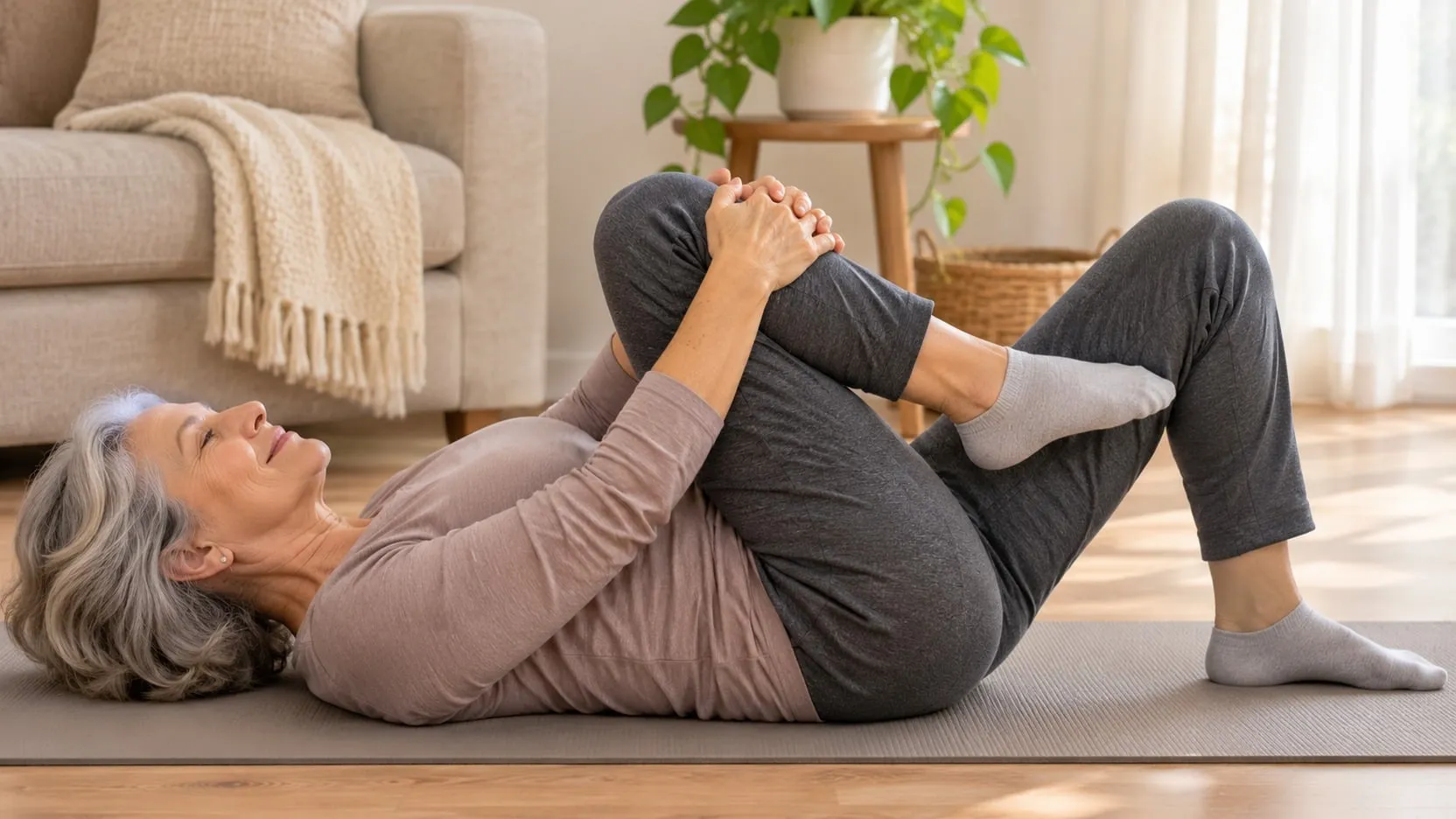
Sciatica exercises are the first thing most people try when pain runs from the buttock down a leg, and for good reason: the main guidelines all start with staying active. This guide gives a gentle routine of sciatica exercises taken from clinical sources, explains why the cause of your sciatica changes which moves suit you, lists what to avoid, and says honestly how strong the evidence is. Each health statement names its source.
What Sciatica Is, and Why the Cause Matters
The Nerve and the Symptoms
The sciatic nerve runs from the lower back down the back of each leg. The NHS describes sciatica as irritation or compression of that nerve, with a sharp or burning pain, tingling, numbness or weakness, usually in the bottom and the back of one leg, often into the foot; back pain may be there too but is usually not as bad as the leg pain (NHS, 2024).
StatPearls adds a warning: any low back or leg pain is often mislabeled sciatica, and true sciatica pain is made worse by bending the lower spine forward, twisting, bending or coughing (StatPearls, 2024).
Common Causes
The NHS lists a slipped disc as the most common cause, followed by spinal stenosis (narrowing where the nerves pass), spondylolisthesis (a vertebra slipping) and back injury (NHS, 2024). Mayo Clinic notes that sitting a lot, a job that involves twisting or heavy loads, and extra weight are risk factors (Mayo Clinic).
Why One Routine Doesn’t Suit Everyone
Many people with low back pain have a preferred direction of movement: in the McKenzie research summarized by StatPearls, 67% to 85% of those whose pain centralizes prefer extension, or bending backward, and exercises in the wrong direction did worse in a randomized trial; spinal stenosis falls outside that group (Mann, 2025). Many people with stenosis find the opposite, that sitting or bending forward eases the leg. A tight piriformis in the buttock responds to hip stretches. That is why the routine below is gentle and mixed, and why the most important instruction is to watch what happens to your leg pain.
What the Evidence Says About Sciatica Exercises
Staying Active Comes First
A Cochrane review found moderate-quality evidence that, for sciatica, advice to rest in bed made little or no difference compared with advice to stay active (Dahm et al., Cochrane, 2010). Since bed rest has downsides of its own, the guidelines lean toward activity: NICE tells clinicians to encourage people with low back pain and sciatica to continue normal activities, and to consider a group exercise programme for a flare-up (NICE, 2016).
Structured Exercise Versus Advice
A 2015 meta-analysis of five trials found low-quality evidence that structured exercise gives a small short-term benefit over advice to stay active for leg pain, and moderate-quality evidence of no difference in leg pain or disability in the long term (Fernandez et al., 2015). A systematic review of 18 physiotherapy trials, published in 2023 and covering 2,699 people, concluded that the evidence is not good enough to make firm recommendations, because most trials were at high risk of bias and very different from each other (Dove et al., 2023).
What That Means for You
Exercise is a reasonable, low-risk way to stay active and may ease leg pain a little sooner. No particular routine has been shown to be the best. So pick moves that feel tolerable, build up slowly, and keep walking. For low back pain more broadly, the American College of Physicians also puts exercise among its first-choice, non-drug treatments for chronic pain (Qaseem, 2017).
A Gentle Sciatica Exercise Routine
These sciatica exercises come from Mayo Clinic’s back routine and Kaiser Permanente’s sciatica sheet. Start slowly and ease off if an exercise starts to hurt (Kaiser Permanente, 2026). If you have ongoing back pain or a recent injury, Mayo Clinic advises asking a physical therapist which activities are safe for you first (Mayo Clinic, 2026).
1. Short Walks
Kaiser Permanente suggests short walks of 10 to 20 minutes every 2 to 3 hours, avoiding slopes, hills and stairs until you feel better, and walking only as far as you can without more leg pain. It also says not to stay in one position too long (Kaiser Permanente, 2026).
2. Knee-to-Chest Stretch
Lie on your back with knees bent and feet flat. With both hands, draw one knee toward your chest, tighten your stomach and press your spine into the floor. Hold for five seconds, then switch legs, then do both together. Repeat each 2 to 3 times (Mayo Clinic, 2026). This is a forward-bending stretch: if it sends pain down your leg, as it can with a disc, leave it out.
3. Lower Back Rotational Stretch
From the same position, keep your shoulders on the floor and slowly roll your bent knees to one side. Hold for 5 to 10 seconds, return, then go to the other side. Repeat 2 to 3 times per side (Mayo Clinic, 2026).
4. Pelvic Tilt
On your back with knees bent, tighten your stomach so your lower back lifts slightly from the floor, hold five seconds and relax; then flatten your back toward the floor, hold five seconds and relax. Start with five repetitions a day and slowly work up to 30 (Mayo Clinic, 2026).
5. Bridge
On your back with knees bent, tighten your stomach and buttocks, then lift your hips into a straight line from knees to shoulders. Hold for three deep breaths and lower. Start with five a day and work up to 30 (Mayo Clinic, 2026).
6. Cat-Cow
On hands and knees, round your back up toward the ceiling and hold about 15 to 30 seconds, then let it curve down, lifting your buttocks, and hold again. Move smoothly between the two positions 2 to 4 times (Kaiser Permanente, 2026). Mayo Clinic’s version uses 3 to 5 repetitions twice a day (Mayo Clinic, 2026).
Matching Sciatica Exercises to the Cause
Pain From a Disc
If a disc is the cause, many people do better with gentle backward bending, such as lying face down and pressing up on the elbows. Our herniated disc exercises guide gives that sequence step by step, with the pain rule clinicians use. The structured version of this approach is the McKenzie method, covered in our McKenzie exercises guide.
Pain From the Piriformis
If the pain sits deep in the buttock and gets worse with sitting, a tight piriformis muscle may be irritating the nerve. Our piriformis stretch guide covers the three main stretches and how to tell it apart from a disc.
A Nerve That Feels Tight
Some clinicians use gentle nerve glides, moving the leg and neck together so the nerve slides rather than stretches. Our nerve flossing guide sets out how they are done and what the evidence does and doesn’t show.
Narrowing of the Spinal Canal
Spinal stenosis, a narrowing where the nerves pass, is one of the causes the NHS lists (NHS, 2024). Many people with it find that sitting or bending forward eases the leg, so the knee-to-chest stretch and pelvic tilt above may suit them better than press-ups. That is a pattern, not a rule, and a clinician’s examination is the way to know which one you have.
What to Avoid With Sciatica
Long Bed Rest and Long Sitting
The NHS says not to sit or lie down for long periods; even if moving hurts, it is not harmful and can help you recover faster (NHS, 2024). If sitting is unavoidable, Mayo Clinic suggests a seat with good lower back support, armrests and a swivel base (Mayo Clinic), and getting up often.
Forcing Painful Stretches
Toe touches, deep forward folds and hard hamstring stretches are common internet advice, and they bend the spine forward, the movement StatPearls says tends to aggravate sciatica (StatPearls, 2024). They may suit you later; during a flare-up, gentler moves are safer.
Heavy Lifting and Twisting
Heavy loads, sudden twisting and high-impact exercise can stir up an irritated nerve. Take a break from them while the leg is painful, then return gradually.
Sleeping Positions That Strain the Back
How you lie at night matters too. Our guide to the best sleeping position for sciatica covers that on its own.
When to See a Doctor About Sciatica
Emergency Care
The NHS says to go to the emergency department or call emergency services if you have sciatica on both sides, weakness or numbness in both legs that is severe or getting worse, numbness around or under your genitals or around your bottom, or new trouble starting, stopping or controlling urine, or noticing and controlling bowel movements (NHS, 2024). Mayo Clinic adds sudden numbness or weakness in a leg and pain after a violent injury, such as a traffic accident (Mayo Clinic). In the U.S., call 911 or go to an emergency room.
Book an Appointment If
- Self-care has not helped, or the pain lasts longer than a week, is severe or is getting worse, which is Mayo Clinic’s threshold (Mayo Clinic).
- The pain has not improved after a few weeks of home treatment, or it stops you doing your normal activities, which is the NHS threshold (NHS, 2024).
- You have a history of cancer, a fever, unexplained weight loss or a recent injury along with the pain. NICE tells clinicians to rule out specific causes such as cancer, infection, trauma and inflammatory disease, especially when symptoms are new or change (NICE, 2016).
Tools That May Help, and What They Can’t Do
Heat
The NHS suggests holding heat packs to the painful areas (NHS, 2024). A heat pack eases the ache; it doesn’t treat the nerve.
Inversion and Traction
Hanging upside down is often promoted for sciatica, but the guidelines are cautious about traction for it. Our page on inversion tables for sciatica sets out what the guidelines actually say before you spend money on one.
A Simple Week of Sciatica Exercises
| When | What to do |
|---|---|
| Every 2 to 3 hours while awake | A 10 to 20 minute walk on flat ground, as far as your leg allows |
| Morning and evening | Knee-to-chest, lower back rotation and cat-cow, 2 to 3 slow reps each |
| Once a day | Pelvic tilts and bridges, starting at five each |
| Through the day | Get up from your chair every half hour or so |
This is our arrangement of the clinical sources above into a week, not a tested program. Drop any move that sends pain down your leg, and add reps slowly as your leg calms.
Putting Sciatica Exercises to Work
Keep moving, little and often. Walk several times a day, do the gentle routine morning and evening, and avoid long spells in bed or in a chair. Watch your leg: pain retreating toward the back is good; pain spreading down the leg means drop that move. Most sciatica settles within weeks to months. If it doesn’t, or if any warning sign appears, the next step is an examination, because finding the cause, a disc, the piriformis or a narrowed canal, is what tells you which exercises will help most.
Your questions, answered
Frequently Asked Questions
Should you rest with sciatica?
Only briefly. A Cochrane review found that, for sciatica, advice to rest in bed did no better than advice to stay active, and lying down for long periods stiffens the back. The NHS advice is to keep up normal activities as much as you can. Rest in a comfortable position when you need to, then get moving again.
Is walking good for sciatica?
For most people, yes. Short walks are one of the simplest ways to stay active, and Kaiser Permanente's sciatica sheet suggests 10 to 20 minutes every 2 to 3 hours, on flat ground, only as far as you can go without leg pain getting worse. If walking clearly brings on more leg pain, shorten it and get checked.
What's the worst thing you can do for sciatica?
Ignoring warning signs is worst: weakness in both legs, numbness around the genitals or bottom, or new bladder or bowel trouble need emergency care. Beyond that, the common mistakes are long bed rest, sitting for hours without a break, and forcing stretches that send pain further down the leg.
How long does sciatica usually last?
It usually gets better within a few weeks to a few months, according to the NHS, though it can last longer and can come back. Mayo Clinic says to call a clinician if pain lasts longer than a week, is severe or gets worse. Most people recover fully, often without surgery.
What is commonly mistaken for sciatica?
Plain low back pain is the most common one: true sciatica usually hurts more in the leg than the back and follows the nerve below the knee. Piriformis syndrome, where a buttock muscle irritates the nerve, hip problems and hamstring injuries can feel similar. A clinician's examination is the reliable way to tell them apart.
Does touching your toes help sciatica?
Usually not during a flare-up. StatPearls notes that sciatica pain tends to get worse with bending the lower spine forward, twisting and bending, which is exactly what a toe touch does. Some people tolerate it later on. If it sends pain further down your leg, drop it and try a gentler move.
11 sources used for this guide
Each linked to the original. Citations in the text jump here.
View sources
NHS. Sciatica. nhs.uk, page last reviewed 3 December 2024.
Davis D, Taqi M, Vasudevan A (StatPearls). Sciatica. StatPearls Publishing, 2024.
Mayo Clinic Staff. Sciatica: Symptoms and causes. mayoclinic.org.
Dahm KT, Brurberg KG, Jamtvedt G, Hagen KB. Advice to rest in bed versus advice to stay active for acute low-back pain and sciatica. Cochrane Database of Systematic Reviews 2010;(6):CD007612.
National Institute for Health and Care Excellence (NICE). Low back pain and sciatica in over 16s: assessment and management, Recommendations. NICE guideline NG59, published 30 November 2016, last updated 29 July 2026.
Kaiser Permanente Health Encyclopedia (WebMD Ignite Staff, Clinical Review Board). Sciatica: Exercises. healthy.kaiserpermanente.org, current as of 24 September 2026.
Mayo Clinic Staff. Back exercises in 15 minutes a day. mayoclinic.org, 22 July 2026.
Fernandez M, Hartvigsen J, Ferreira ML, Refshauge KM, Machado AF, Lemes IR, Maher CG, Ferreira PH. Advice to Stay Active or Structured Exercise in the Management of Sciatica: A Systematic Review and Meta-analysis. Spine 2015;40(18):1457-1466.
Dove L, Jones G, Kelsey LA, Cairns MC, Schmid AB. How effective are physiotherapy interventions in treating people with sciatica? A systematic review and meta-analysis. European Spine Journal 2023;32(2):517-533.
Qaseem A, Wilt TJ, McLean RM, Forciea MA, Clinical Guidelines Committee of the American College of Physicians, et al. Noninvasive Treatments for Acute, Subacute, and Chronic Low Back Pain: A Clinical Practice Guideline From the American College of Physicians. Annals of Internal Medicine 2017;166(7):514-530.
Mann SJ, Stretanski MF, Singh P. McKenzie Back Exercises. StatPearls, StatPearls Publishing, 2025.