Health guide
How to Do Inverted Sit-Ups Safely, Hanging From Gravity Boots or an Inversion Table
By the IntoInversion teamUpdated
- 11 sources
- 10 min read
We earn from qualifying purchases made through our links.
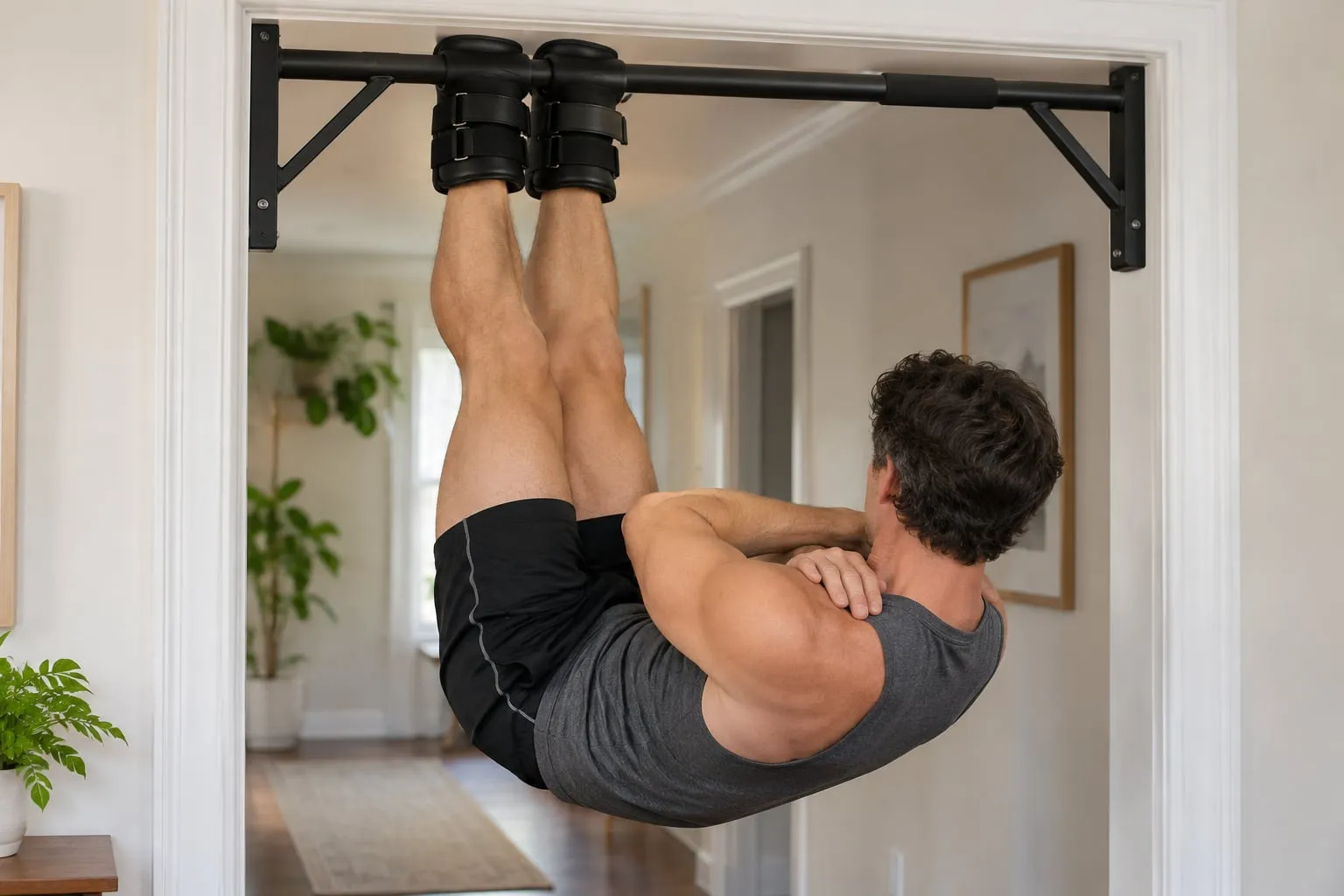
Two very different exercises share the name. One is a floor movement where the hips curl up toward the ribs. The other is the one this page is about: you hang from your ankles, or lie tilted on an inversion table, and bring your torso up toward your knees against gravity. It looks dramatic in videos, and it asks more of your setup and your body than a floor crunch does. We did not test anyone. Every instruction below comes from a named maker or study, and where nobody has published one, we say so.
What Inverted Sit-Ups Are
An inverted sit-up starts with your body already upside down. Your ankles are locked into boots hooked over a bar, or your feet are held by the ankle system of an inversion table. From there you tighten your stomach and bring your chest toward your knees, then lower back to the hanging position.
Inverted Sit-Ups vs Reverse Sit-Ups and Reverse Crunches
The words get mixed up. A reverse crunch is done lying on your back: your knees stay bent above your hips and you roll the spine up so the pelvis moves toward the ribs. ACE Fitness describes it as raising the hips off the mat “as if trying to bring your knees towards your head” and lowering the spine back with control (ACE exercise library, reverse crunch). Nothing hangs and your head stays up. A reverse sit-up usually means that same floor move.
An inverted sit-up is the hanging one. Your head is below your heart, your feet are anchored above you, and the work of lifting your torso is done against your own body weight. If you search for a floor exercise, you want the head-up alternatives near the end of this page.
Inverted Crunches vs Full Sit-Ups
Teeter separates two moves on its table. For the inverted crunch you “cross both arms on your chest” and use your abdominals to crunch forward (Teeter, 2015). For the inverted sit-up you bend the knees slightly, tighten your abs and reach your arms toward your knees, lifting the whole torso (Teeter, 2015). The crunch is the shorter movement and the sit-up is the full range. Treat them as two steps, not two names for the same thing.
Before You Hang: The Setup Checks
Most of the risk in this exercise sits in the equipment and in the minutes before you start. A set of boots on a weak bar is a fall waiting to happen, and you will be upside down when it goes.
Boots, Bar and the Lowest Limit
Teeter rates its Gravity Boots to 300 lb, but the Chin-Up Rack it sells for using them at home to only 250 lb (Teeter). Your safe limit is the lower of the two. The same page says the rack mounts to solid wood doorframes 28 to 36 inches wide, and that the boots fit bars up to 1.25 inches in diameter (Teeter).
If you use a gym bar or a rack you already own, the bar’s own limit applies, and a bar no thicker than 1.25 inches is the maker’s requirement. Teeter adds that you should “ensure a secure, durable platform before attempting inversion on non-Teeter equipment” (Teeter). If the bar flexes or moves under your weight, it is the wrong bar. Our gravity boots guide compares boots by calf size, bar fit and weight limit.
Boots also come in sizes. Teeter’s Standard boots fit calves under 16 inches around, and the XL fits 16 inches and up (Teeter). Check your calf before you check the price.
On an Inversion Table
A table supports your back and lets you stop at any angle, which a free hang does not. Teeter describes the difference this way: a table allows “controlled, adjustable inversion,” while boots place you in full inversion (Teeter, 2026).
Teeter tells new table users to limit the first inversions to 20 to 45 degrees with the tether strap and increase the angle gradually (Teeter, 2020). It advises against full 90 degree inversion until you have inverted over several weeks and feel completely comfortable at 60 degrees (Teeter, 2020). It also asks you to use the “Hear, See, Feel, Test” check on the ankle closure before every inversion, with a spotter nearby the first times (Teeter, 2020). Teeter lists crunches and sit-ups as the third stage of its table exercises, after stretching and gentle movement (Teeter, 2020). So no one should start their first week with a sit-up.
How to Do Inverted Sit-Ups on Gravity Boots
Teeter’s boots page names sit-ups as a use and gives no steps for them. Its published sit-up instructions are written for the table. The sequence below keeps to what Teeter publishes about the boots, plus its table description of the movement itself. It is not a tested protocol.
Getting Into Position
- Check the bar or rack: durable, correctly installed, no thicker than 1.25 inches, able to hold your full body weight without moving or flexing (Teeter, 2026).
- Fasten both boots and confirm each hook is fully engaged before you hang (Teeter, 2026).
- Have someone nearby for your first sessions (Teeter, 2026).
- Follow the user guide that came with your boots for mounting. Teeter’s guide, and the shape of your rack, decide how you get up there.
The Rep
- Hang still first. Teeter says to start with shorter sessions so your body can adjust (Teeter, 2026).
- Cross your arms on your chest for the crunch, or reach your arms toward your knees for the full sit-up (Teeter, 2015).
- Tighten your stomach and lift. Teeter says to bend the knees slightly for the sit-up, and to place your hands behind your knees to finish the motion if you need help (Teeter, 2015).
- Lower slowly to the hanging position. To work the obliques, bring one shoulder toward the opposite knee and alternate sides (Teeter, 2015).
How many? No study has set a number for this exercise, and neither has Teeter. A sensible rule is to stop when the lift gets sloppy or you feel pressure in your head, not when you hit a count. Fewer clean reps beat more swinging ones.
Getting Down
Teeter’s advice for coming back up is to take your time and pause halfway, holding the grips with your head upright, then finish the dismount and wait a moment before stepping away (Teeter, 2026). The pause is there to cut the chance of feeling lightheaded. Do not rush it after a set of sit-ups, when you are already breathing hard.
How to Do Inversion Crunches on a Table
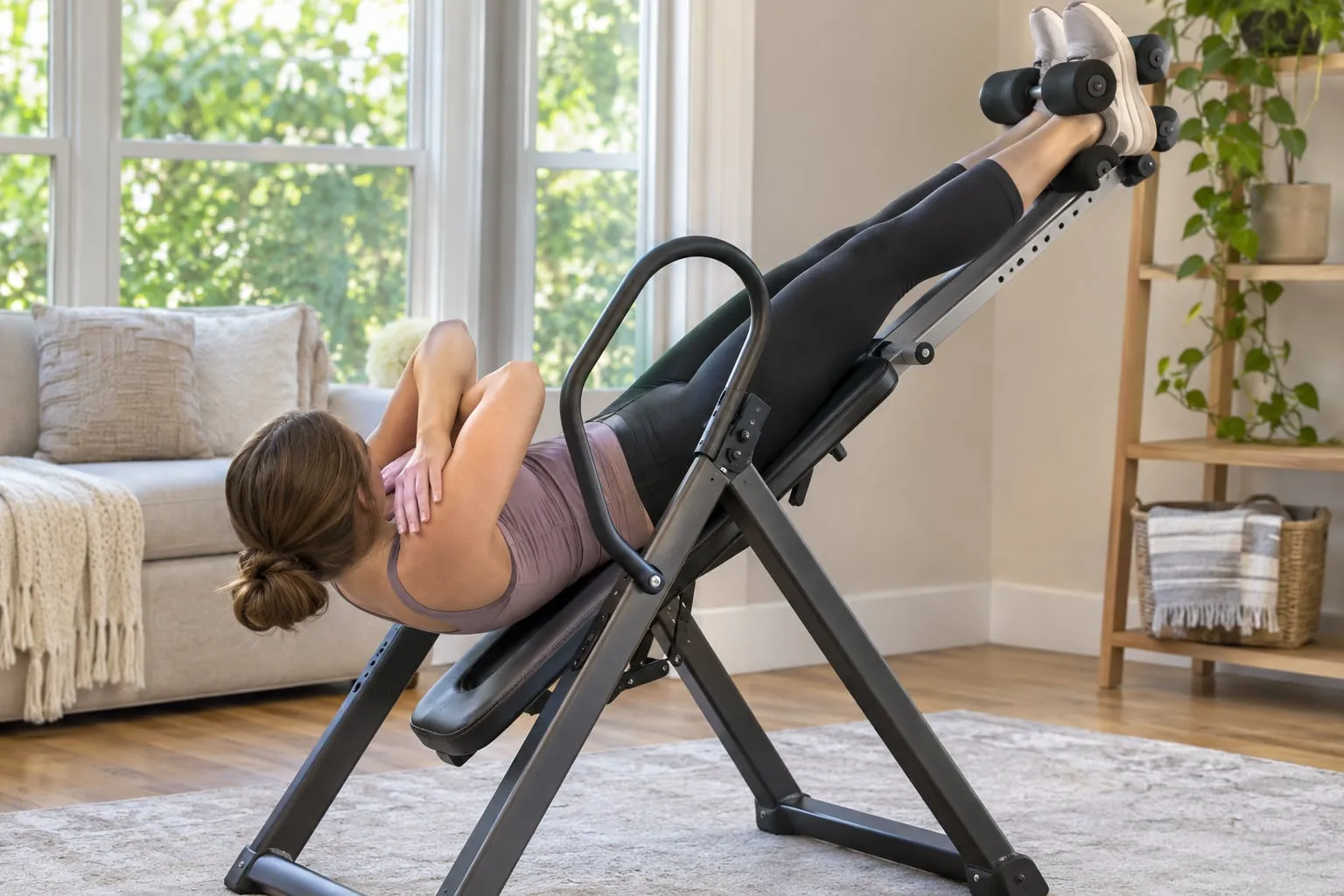
Crunch and Oblique Crunch
Teeter’s wording: cross both arms on your chest, use your abdominals to crunch forward, hold, release and repeat (Teeter, 2015). To add the obliques, bring your right shoulder toward your left knee, then your left shoulder toward your right knee (Teeter, 2015). Teeter lists the rectus abdominis as the muscle for the plain crunch (Teeter, 2015).
Full-Range Sit-Up
For the sit-up, Teeter says to bend the knees slightly, contract the abs and reach toward the knees, using your hands behind the knees if you need assistance (Teeter, 2015). Teeter also says this is “the only form of full-range sit-up that does not place loads on your back” (Teeter, 2015). That claim comes from the maker. We found no biomechanical study that measured it, so read it as marketing and not as a safety result.
Our guide to inversion table exercises for beginners shows where the sit-up sits among Teeter’s twelve moves. That page covers the routine. This one covers the sit-up itself.
Inverted Sit-Ups Muscles Worked
Teeter lists the muscles it says an inverted sit-up works: hip flexor, abdominis muscles, iliopsoas, tensor fasciae latae, rectus femoris, sartorius and tibialis anterior (Teeter, 2015). That is the maker’s list, not a measurement.
What EMG Studies Measured
The best measurement we opened is a 2006 study that used surface electromyography on 21 healthy adults aged 23 to 43 (Escamilla, 2006). It tested several abdominal exercises, among them the bent-knee sit-up, the reverse crunch on a 30 degree incline and the hanging knee-up in straps. It did not test an inverted sit-up, so it cannot tell you how hard that move works your abs. It only shows how nearby exercises compare.
In that study the upper and lower rectus abdominis, internal oblique and latissimus activity were highest for the Power Wheel, the hanging knee-up with straps and the inclined reverse crunch (Escamilla, 2006). The measures were activity levels in muscles, not strength gains or fat loss.
Hip Flexors Do a Lot of the Work
The same study found rectus femoris activity, a hip flexor, was highest for the Power Wheel pike and knee-up, the inclined reverse crunch and the bent-knee sit-up. The authors say this may be problematic for some people with low back problems (Escamilla, 2006). Teeter’s own list for the inverted sit-up includes hip flexors, iliopsoas and rectus femoris (Teeter, 2015). If your back is sensitive, the hip flexors are a reason to be careful, even though the sit-up is done upside down.
Are Inverted Sit-Ups Safe?
No source we opened calls them safe for everyone. What we have is the maker’s guidance and two measured effects of being upside down.
Blood Pressure and Eye Pressure Upside Down
In a randomized trial of 60 women aged 20 to 30, two minutes of inversion raised both systolic and diastolic blood pressure compared with standing controls (Haskvitz, 1986). The authors said hypertensive people may need to avoid inversion. In a separate study, five minutes fully inverted raised eye pressure from 16.8 to 32.9 mm Hg in healthy eyes and from 21.3 to 37.6 mm Hg in eyes with glaucoma (Weinreb, 1984). The visual fields did not change, but the authors recommended that people with ocular hypertension or glaucoma avoid it.
Both abstracts describe hanging, not exercising. We found no study of what a set of sit-ups does while you are inverted, so do not assume it is gentler than hanging still.
How Long to Stay Inverted
Teeter tells table users to begin with 1 to 2 minutes and work up to 3 to 5 minutes only as comfort allows (Teeter, 2014). That is the maker’s guidance for the table, not a study result. A set of sit-ups counts toward the time you spend upside down, so keep the whole session short. Our guide on how long you can hang upside down covers the time limits and what is known about the risks.
Who Should Not Do Them
Teeter’s boots guidance tells people with high blood pressure, glaucoma, heart-related conditions, osteoporosis, pregnancy or a history of spinal injury or surgery to talk with a doctor first (Teeter, 2026). Its table materials list more, including anticoagulant use, retinal detachment, hernias and recent surgery (Teeter). Read our full page on who should not use inversion tables before you buy anything.
Head-Up Alternatives
If the risks above apply to you, or you would rather not hang, the same hip-curl pattern works with your head up.
Reverse Crunch on the Floor or a Bench
Lie on your back with your knees bent above your hips. Roll your spine up off the mat and lower it with control, as ACE describes (ACE exercise library, reverse crunch). In Escamilla’s study the reverse crunch inclined 30 degrees was among the exercises with the highest abdominal activity (Escamilla, 2006). It was also among the highest for the rectus femoris, so it is not automatically back-friendly (Escamilla, 2006). Keep it slow and stop if your back complains.
Hanging Leg Raises
If you can hang but do not want to be upside down, the hanging knee raise is the right-side-up version. In the same study, the hanging knee-up with straps was among the top exercises for abdominal activity (Escamilla, 2006). Our hanging leg raises guide has the form and a six-step progression.
Ab Straps
Straps loop over a bar and hold your upper arms, so your grip is not the limit. They are the setup used in the 2006 study (Escamilla, 2006). See our ab straps comparison for how the pairs differ in padding, hooks and fit.
Equipment for Inverted Sit-Ups
Pick for the lowest limit in the setup, not the best single part. Boots need a bar rated for your weight, and a table needs the right angle control and ankle system. These are the ones worth a look for this exercise.

Boots and rack in one boxMaker source
Teeter Gravity Boots + Inversion Rack
by TEETER
Best for people who want boots and a doorway rack from the same maker, with the rack's 250 lb limit in mind.
Skip it if you weigh more than 250 lb, have no solid wood doorframe 28 to 36 inches wide, or have any condition from the safety section above.
Boots and a doorway rack from the same maker, with every limit published. The rack's 250 lb rating, not the boots' 300 lb, is the one that applies.
- Weight limit
- 250 lb
- Warranty
- 5 years
- Price range
- Mid-range
What we like
- Boots and rack from one maker, limits published
- Screw-mounted brackets, not a pressure fit
- Dual bars make getting on and off easier
- Calf loops and EZ-Up strap included
Keep in mind
- Rack rated to only 250 lb
- Needs a solid wood doorframe 28 to 36 in wide
- Full inversion the moment your feet leave the floor
- Calves of 16 in or more need the XL set
Full specs
- Price range
- Mid-range
- Weight capacity
- 250 lb
- Angle control
- No angle control: hanging from the bar puts you fully inverted at once
- Ankle system
- Standard padded boots with dual self-locking buckles, 2.5 in hooks and removable calf loops
- Door and frame fit
- Standard boots fit ankles up to about 16 in around; the rack fits solid wood doorways 28 to 36 in wide
- Mounting
- Rack screws into the doorframe with quick-disconnect locking brackets (not pressure-mounted); rack rated to 250 lb, boots to 300 lb
- Use
- Hanging, inverted sit-ups and crunches; the dual-bar rack also takes chin-ups and pull-ups
- Warranty
- 5 years full, per the listing
- FDA
- Boots named in Teeter's 510(k) K162702, Class I device type
Maker sourceFrom the maker's product page. Not stated means the maker publishes nothing.
We may earn a commission. It never changes what we pick, or the order picks appear in.

Five-year full warrantyMaker source
Teeter EZ-Up Gravity Boots
by TEETER
Best for people who already have a sturdy bar and want only the boots.
Skip it if your bar is thicker than 1.25 inches or you are not sure what it can hold.
The only gravity boots with a full manufacturer spec sheet, a five-year warranty and an FDA record behind them. Every number on this card is Teeter's own.
- Weight limit
- 300 lb
- Warranty
- 5 years
- Price range
- Budget
What we like
- Five-year full warranty
- Named in Teeter's FDA 510(k) record, K162702
- Calf loops included, for a slight bend at the knee
- Rated to 300 lb, on Teeter's own spec sheet
Keep in mind
- No angle control: you go straight to full inversion
- Teeter's own Chin-Up Rack is rated to only 250 lb
- Bar must be no more than 1.25 in across
- Calves of 16 in or more need the XL size
Full specs
- Price range
- Budget
- Weight capacity
- 300 lb
- Angle control
- No angle control: hanging from a bar puts you fully inverted at once
- Ankle system
- Padded cuffs with dual self-locking buckles and calf loops
- Door and frame fit
- Standard size, for calves under 16 in around
- Mounting
- Bars up to 1.25 in across; Teeter's Chin-Up Rack is rated to 250 lb
- Warranty
- 5 years full
- FDA
- Named in Teeter's 510(k) K162702, Class I device type
Maker sourceFrom the maker's product page. Not stated means the maker publishes nothing.
We may earn a commission. It never changes what we pick, or the order picks appear in.

Long ankle-lock handle, 5-year warrantyMaker source
Teeter FitSpine X3
by TEETER
Best for people who want to do crunches on a table with an adjustable angle instead of a free hang.
Skip it if you have not yet built up to full inversion, or you have glaucoma, high blood pressure or a heart condition.
What the premium over a cheaper table buys is the longer ankle-lock handle, the 5-year warranty against Innova's 1 year, and a tether marked at 20°, 40° and 60°. The Innova ITX9600 also lets you set a limit with a pin whose degrees are listed in its manual, so a marked angle is not exclusive to Teeter.
- Weight limit
- 300 lb
- User height
- 4'8" to 6'6"
- Warranty
- 5 years
- Price range
- Premium
What we like
- Tether marked at 20°, 40° and 60°, set before you get on
- Five-year full warranty, against Innova's one year
- Teeter's tables are FDA 510(k) cleared under K162702
- EZ-Reach ankle lock with an extra-long handle
Keep in mind
- No heat or massage
- No raised boarding platform, unlike the LX9
- Rated to 300 lb, max height 6 ft 6 in
Full specs
- Price range
- Premium
- Weight capacity
- 300 lb
- User height
- 4'8" to 6'6"
- Angle control
- EZ-Angle tether marked at 20°, 40° and 60°; full inversion with secure lockout
- Ankle system
- Deluxe EZ-Reach ankle lock, extra-long handle, micro-adjusting closure
- Heat and massage
- None
- Warranty
- 5 years (extension to 10 sold separately)
- FDA
- 510(k) cleared (K162702), Class I device
Maker sourceFrom the maker's product page. Not stated means the maker publishes nothing.
We may earn a commission. It never changes what we pick, or the order picks appear in.

Our pick for most peopleListing only
plzzree Hanging Ab Straps
by plzzree
Best for people who want the hanging ab work right-side up, with their arms taking the load.
Skip it if you have shoulder problems or no bar that holds your weight.
The lowest spend of our picks with a stated weight limit, 300 lb, padded slings and steel hooks: everything most people need to find out whether straps suit them.
- Weight limit
- 300 lb
- Price range
- Budget
What we like
- 300 lb stated limit
- Padded slings
- Steel hooks
Keep in mind
- Padding thickness not stated
- Strap length not stated
- Warranty not stated in the listing
Full specs
- Price range
- Budget
- Weight capacity
- 300 lb
- Mounting
- Loops over a pull-up bar with stainless steel hooks and loops, per the listing
- Use
- Hanging knee raises and leg raises with the upper arms resting in padded slings
- Warranty
- Not stated
Listing onlyFrom the retail listing; no maker spec sheet
We may earn a commission. It never changes what we pick, or the order picks appear in.
Inverted sit-ups ask a lot of a setup and a body. Check the bar first, the boots second and your health before either, and keep the reverse crunch in your pocket for the days you would rather keep your head up.
Your questions, answered
Frequently Asked Questions
What muscles do reverse sit-ups target?
A reverse sit-up is usually a reverse crunch: you curl the pelvis toward the ribs. In a 2006 lab study, the reverse crunch on a 30 degree incline gave high activity in the upper and lower abdominals, the internal obliques and the lats, plus the hip flexor rectus femoris. An inverted sit-up is a different, hanging movement and was not in that study.
What does a reverse crunch exercise look like?
You lie on your back with your knees bent over your hips. Then you roll your spine up off the mat, bringing your knees toward your head, and lower with control. The movement comes from curling the pelvis, not from swinging the legs. Nothing hangs and your head stays up, so it is the easy substitute for an inverted sit-up.
Why are sit-ups no longer recommended?
We found no authority that has banned them. The caution we could source is narrower: a 2006 EMG study found that the bent-knee sit-up, along with the reverse crunch on a 30 degree incline, produced high hip flexor activity, which the authors said may be a problem for some people with low back problems. If sit-ups hurt your back, ask a physical therapist which core exercise to use instead.
11 sources used for this guide
Each linked to the original. Citations in the text jump here.
View sources
Teeter. How to Exercise on Your Teeter. teeter.com blog, 2015 (updated 2022).
Teeter. How to Use an Inversion Table. teeter.com blog, 2020 (updated 2022).
Teeter (Stl International, Inc.). Gravity Boots & Doorway Inversion Systems (ficha de produto). teeter.com/product/gravity-boots/.
Teeter (Stl International, Inc.). Gravity Boots with Adapter Kit (ficha de produto). teeter.com/product/gravity-boots-adapter-kit/.
Teeter. Gravity Boots: What They Are, How They Work, and How to Get Started. teeter.com blog, April 17, 2026.
Teeter. FAQ: Invert How Long And How Often?. teeter.com blog, 2014 (updated 2025).
Teeter. Are there health issues that would prevent me from inverting?. teeter.com, Support Center (the same list appears in the owner's manual).
Escamilla RF, Babb E, DeWitt R, Jew P, Kelleher P, Burnham T, Busch J, D'Anna K, Mowbray R, Imamura RT. Electromyographic analysis of traditional and nontraditional abdominal exercises: implications for rehabilitation and training. Physical Therapy 2006;86(5):656-671.
American Council on Exercise. Reverse Crunch. ACE Exercise Library, acefitness.org.
Haskvitz EM, Hanten WP. Blood pressure response to inversion traction. Physical Therapy 1986;66(9):1361-1364.
Weinreb RN, Cook J, Friberg TR. Effect of inverted body position on intraocular pressure. American Journal of Ophthalmology 1984;98(6):784-787.